Ikigai and Longevity:
What the Science Actually Says
People in Okinawa don't try to live to 100. They just keep showing up to what matters to them — and the years accumulate. The science behind why turns out to be more specific than anyone expected.
The connection between ikigai and longevity gets repeated often enough that it risks becoming motivational wallpaper. But beneath the poster version, there is actual longitudinal research — peer-reviewed, large-sample, rigorously controlled — that makes a specific and striking case for why having a reason to get up in the morning affects how long you do it.
This article goes through that evidence without softening it into inspiration. Then it draws the line that most longevity content misses: the same mechanisms that extend lifespan are the same ones that make the years worth inhabiting. That has direct implications for how you design your work — not just your retirement.
Table of contents
- What Does "Ikigai" Actually Mean — Before We Talk About Lifespan?
- What Does the Research Actually Show Between Ikigai and Longevity?
- Why Does Ikigai Affect Lifespan? The Three Mechanisms
- Does This Mean Ikigai Is the Same as "Having a Job You Like"?
- What Does "Ikigai Extends Life" Mean If You're 35, Not 75?
- What Does the Research Say About Ikigai That Most People Get Wrong?
- What Are the Practical Implications If You Want to Apply This?
- Longer Isn't the Goal. Fuller Is.
- Frequently Asked Questions
What Does "Ikigai" Actually Mean — Before We Talk About Lifespan?
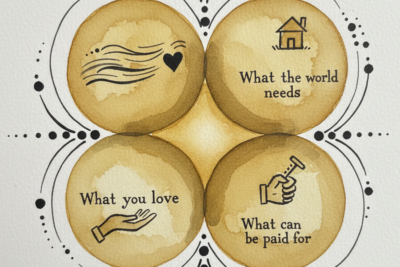
The four-circle Venn diagram that most people associate with ikigai — love / good at / world needs / paid for — was not created in Japan. It was adapted by a blogger named Marc Winn in 2014 from a purpose diagram by Spanish astrologer Andres Zuzunaga, and the two were merged under the ikigai label. The original concept is broader and simpler.
Ikigai combines two Japanese words: iki (life, or being alive) and gai (worth, value, benefit). Together: "that which makes life worth living." In the most authoritative Japanese dictionary, Kojien, it is defined as "the motivation to live; something that makes you happy to be alive."
Crucially, ikigai in its original form is not primarily a career concept. In a survey of 2,000 Japanese people, only one third cited work as their ikigai. It encompasses relationships, hobbies, community contribution, small daily pleasures — any engagement that gives the day genuine texture.
That distinction matters for understanding the longevity research, which measures ikigai as a felt sense of purposeful engagement — not specifically as career alignment, though career is one of its largest containers for working-age adults.
What Does the Research Actually Show Between Ikigai and Longevity?
This is where it stops being folk wisdom. Three bodies of research are worth examining directly.
The NIH / PMC longitudinal study (2022) — the most comprehensive to date
Published in PLOS ONE via PMC/NIH, this study tracked over 14,000 Japanese adults aged 65 and older across two national cohorts, measuring ikigai in 2013 and health outcomes in 2016, with controls adjusted to the 2010 baseline to minimize reverse causation. It is the most rigorous ikigai-health study conducted to date.
🧠
Dementia Risk
−36%
Lower risk of developing dementia among those who reported having ikigai vs. those who did not.
🦽
Functional Disability
−31%
Lower risk of developing functional disability — the ability to perform daily activities independently.
😔
Depressive Symptoms
Significant
Reduced depressive symptoms and hopelessness — with a bidirectional relationship confirmed.
😊
Life Satisfaction
Significant
Improved happiness and subjective wellbeing, persistent across socioeconomic strata.
The Tohoku cohort study — cardiovascular mortality
A seven-year study following more than 40,000 Japanese adults found that those with a low sense of ikigai had significantly higher overall mortality risk, driven primarily by cardiovascular disease. The association held after adjusting for age, smoking, alcohol use, and hypertension history. — Cited in NessLabs review of ikigai research
The Okinawan male cohort — stroke and cardiovascular disease
Research on men in Okinawa with a strong sense of purpose showed a 72% decrease in stroke risk and a 44% decrease in cardiovascular disease mortality compared to those without a reported sense of ikigai. These are not marginal differences — they are effect sizes that most pharmaceutical interventions fail to match.
72%
lower stroke risk among Okinawan men with a strong sense of ikigai, alongside a 44% reduction in cardiovascular mortality. For context: regular moderate exercise reduces cardiovascular mortality risk by approximately 30–35%. Having a reason to get up in the morning appears to outperform many lifestyle interventions on this measure.
Why Does Ikigai Affect Lifespan? The Three Mechanisms
Correlation findings invite the question of mechanism. Why would a felt sense of purpose reduce dementia risk or cardiovascular mortality? There are at least three documented pathways.
Mechanism 1: Neurochemical regulation
Research shows that the feeling of ikigai is associated with more balanced secretion of serotonin, dopamine, and endorphins. These are not just mood chemicals — they are systemic regulators. Chronic low-level cortisol (the stress hormone) is implicated in cardiovascular disease, immune suppression, and accelerated cognitive decline. Purpose-driven engagement reduces baseline cortisol.
Put simply: having something to care about keeps your neurochemistry closer to its functional baseline. Absence of purpose pushes it toward chronic stress physiology.
Mechanism 2: Behavioral consistency
People with ikigai maintain health-sustaining behaviors more reliably — not because they are disciplined, but because the behaviors serve something they care about. Regular physical activity, sustained social engagement, consistent sleep — these are harder to maintain when the day has no anchor.
The NIH study confirmed that having ikigai was associated with higher rates of physical activity. The relationship appears bidirectional: activity supports ikigai, and ikigai motivates activity.
Mechanism 3: Social integration
Ikigai in Okinawan communities is not a private psychological state — it is practiced in public. The centenarians studied participated in community centers, tended gardens together, competed in friendly sports well into their 90s. Social isolation is now classified as a mortality risk factor comparable to smoking 15 cigarettes a day. Ikigai, as practiced in its original cultural context, is inherently a social behavior.
| Mechanism | What it does biologically | What breaks down without it |
|---|---|---|
| Neurochemical regulation | Balances cortisol, serotonin, dopamine; reduces chronic stress physiology | Elevated baseline cortisol → cardiovascular strain, immune suppression, cognitive decline |
| Behavioral consistency | Sustains exercise, sleep, and social engagement because they serve a purpose | Loss of motivation → sedentary patterns, poor sleep, isolation |
| Social integration | Embeds individual in community structures with reciprocal care and accountability | Isolation → inflammation, cognitive decline, all-cause mortality increase |
Okinawa is one of five Blue Zones identified by researcher Dan Buettner. Purpose — not just diet — is a defining shared factor.
Does This Mean Ikigai Is the Same as "Having a Job You Like"?
No — and conflating the two is one of the most common misreadings of both the research and the concept.
The longitudinal studies measure ikigai as a reported psychological state: do you feel your life has worth? Does something pull you toward the day? They don't measure job satisfaction directly. And in Japan, only a third of people identify their work as their primary ikigai.
But here's what the data does suggest: for working-age adults in industrialized societies, work is the primary arena where ikigai is experienced — or denied. A 40-hour week with no engagement, no sense that your skills are being used, no visible meaning in what you're producing — that is not a neutral state. It actively suppresses the neurochemical and behavioral conditions that the longevity research identifies as protective.
"The oldest people I interviewed in Okinawa were not people who had found a perfect career. They were people who had found a way to be useful every day. The shop assistant who took her job as a service to others. The farmer who saw his vegetables as a gift to his community. The distinction was orientation, not occupation."
— Observed across centenarian interviews documented in Blue Zones research
The implication for career design is direct: the goal is not to find a perfect job. It is to design work that creates a felt sense of contribution, engagement, and fit — the same internal state that the research associates with lower dementia risk, lower cardiovascular mortality, and better functional health in old age.
What Does "Ikigai Extends Life" Mean If You're 35, Not 75?
Most of the longevity research focuses on older adults because that's where measurable health outcomes accumulate. But the biological mechanisms — cortisol regulation, behavioral consistency, social integration — are active throughout adult life, not just in the final decades.
Chronic disengagement at 35 is not a longevity problem yet. It is a cortisol problem, a sleep problem, a motivation problem, a relationship problem. All of these accumulate. Atherosclerosis begins in your 20s; cardiovascular disease becomes visible in your 50s. The biology of purpose deprivation is a slow process, not a sudden event.
What Does the Research Say About Ikigai That Most People Get Wrong?
Three things, specifically.
1. Ikigai is not the Venn diagram
The four-circle career diagram is a useful thinking tool. But the research does not measure it. Studies measure ikigai as a felt state — a sense that life has worth, that today has direction. You can have that while doing work that doesn't perfectly intersect four circles. And you can have the diagram and none of the feeling. The state matters more than the framework that describes it.
2. Ikigai is not a retirement strategy
The research on Okinawan centenarians is sometimes read as: "they live long because they stayed active after retirement." But many of them never retired in any meaningful sense. There is no direct Japanese equivalent of the English concept of retirement — a full stop to purposeful engagement. The model isn't "work hard, then rest." It is "stay connected to contribution, at whatever scale the season allows."
3. The effect is not small
A 36% reduction in dementia risk. A 72% reduction in stroke risk. These are not the marginal benefits of a wellness trend. They are effect sizes that most pharmaceutical and lifestyle interventions don't reach. The absence of purpose in life is, by the numbers, a significant health risk factor — comparable in magnitude to obesity or physical inactivity. It has just never been on a doctor's checklist.
What Are the Practical Implications If You Want to Apply This?
The research suggests a few things worth taking seriously.
- Felt purposefulness matters more than job title. You can have an impressive role and no ikigai. You can have a modest role and strong ikigai. The biology responds to the felt state, not the resume line.
- Social dimension is not optional. Ikigai in isolation is not the same as ikigai practiced in community. The Okinawan centenarians were embedded in moai — tight social groups with mutual obligation. Connection amplifies the protective mechanisms.
- It is dynamic, not a single discovery. Ikigai changes across life stages. What engages you at 28 may not at 48. The Japanese government's own policy framework acknowledges that mid-career adults who lose their primary source of ikigai — through role change, retirement, or children leaving home — face measurable health risks. The design work is ongoing.
- Small daily engagement counts. The research does not require grand purpose. It requires felt engagement — which can come from a well-made espresso, a meaningful conversation, a garden, a craft, or work that uses you properly. Accumulation of small purposeful moments is, neurochemically, the same signal as a single large purpose.
Longer Isn't the Goal. Fuller Is.
The longevity research on ikigai is real and it is specific. Documented reductions in dementia, stroke, cardiovascular mortality, and functional disability are not modest effects — they are among the largest that lifestyle and psychological factors produce in the evidence base.
But living longer without the conditions that make ikigai possible is not actually the point. The Okinawan centenarians didn't optimize for lifespan. They optimized for usefulness, connection, and engagement — and the lifespan followed. The mechanism runs in that direction: purpose → biology → years. Not the other way around.
If you're spending most of your waking hours in work that doesn't engage you, the question isn't whether it will eventually affect your health. It will. The question is whether that's a price you've consciously chosen to pay — or one you haven't yet noticed you're paying.
Frequently Asked Questions
Is there real scientific evidence linking ikigai to a longer life?
Yes — and it's more specific than the popular version suggests. A longitudinal NIH-linked study tracking over 14,000 Japanese adults found that having ikigai was associated with a 31% lower risk of functional disability and a 36% lower risk of dementia. A separate 7-year Tohoku cohort study found higher all-cause mortality among those with low ikigai, driven primarily by cardiovascular disease. These are peer-reviewed, controlled findings — not anecdotes from motivational books.
Why do people in Okinawa live so long — is ikigai the reason?
Ikigai is one of several factors. Blue Zones researcher Dan Buettner identified diet (plant-heavy, calorie-modest), regular low-intensity movement, and strong social ties as co-equal contributors. Ikigai is the purpose dimension — distinct from diet or exercise, but interacting with both. People with ikigai tend to exercise more consistently, maintain social ties, and experience lower chronic stress. The factors reinforce each other rather than operating independently.
Does ikigai have to come from your career to affect your health?
No. The research measures ikigai as a felt psychological state, not a job description. In surveys of Japanese people, only about a third identify work as their primary ikigai. Relationships, hobbies, community contribution, and daily practices all qualify. However, for working-age adults in full-time employment, work is the largest single container of daily hours — which makes it the most impactful arena where ikigai is either present or absent.
What is the biological mechanism that connects purpose to longer life?
Three main pathways: neurochemical (purpose-driven engagement balances cortisol, serotonin, and dopamine, reducing chronic stress physiology), behavioral (people with ikigai maintain health-sustaining habits more consistently, including exercise and sleep), and social (ikigai is practiced in community, and social integration is independently associated with reduced mortality — roughly equivalent in effect size to quitting smoking).
Is the four-circle ikigai Venn diagram used in the longevity research?
No. The four-circle diagram (love / good at / world needs / paid for) was adapted from a Western purpose framework in 2014 and merged with the ikigai label. The longitudinal health research measures ikigai as a reported psychological state — a felt sense that life has meaning and direction. The diagram is a useful career design tool, but it is not what the scientists are measuring when they find reduced dementia or stroke risk.
7 Ikigai Mistakes That Keep You Stuck (And How to Fix Them)
Ikigai Japanese Philosophy: What Most People Get Wrong
Ikigai vs Purpose: They're Not the Same Thing
Ikigai Examples: Real People, Real Careers, Real Intersections

What Is Ikigai? The Full Guide — Beyond the Diagram
Leave a Reply
Related posts