

What Is Ikigai? The Full Answer
— Beyond the Diagram
Ikigai is not the diagram. That's the first thing worth knowing. The four overlapping circles you've seen everywhere online were invented in 2014 — by a British blogger, not a Japanese philosopher. The concept itself is much older, subtler, and more useful than the poster version suggests.
Ikigai (pronounced ee-key-GUY) is a Japanese word meaning roughly "that which makes your life worth living." It's been part of Japanese culture since at least the Heian period (794–1185) and was first studied academically in 1966. The four-circle Venn diagram came more than half a century later.
Both versions are worth understanding — because they answer different questions. This article gives you the full picture: the real etymology, the honest history, the diagram explained correctly, and — critically — how to actually use it as a design tool if you're trying to build a career that fits.
Table of contents
- What Does Ikigai Mean? The Word Itself
- Where Did Ikigai Come From? The Real History
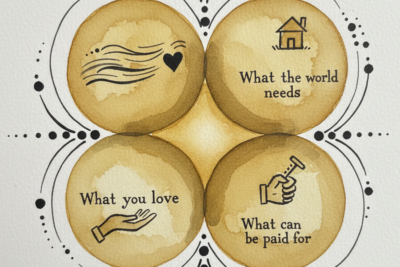
- The Ikigai Diagram Explained — All Four Circles
- The Two Versions of Ikigai — And Why It Matters Which One You Use
- What Ikigai Is Not — Three Misconceptions Worth Clearing Up
- Why Does Ikigai Matter for Your Career Specifically?
- How Do You Actually Find Your Ikigai? Where to Start
- Ikigai Is a Map, Not a Destination
- Frequently Asked Questions
What Does Ikigai Mean? The Word Itself
The word is a compound of two Japanese terms. Not one word, two — and the difference matters.
生き
Iki
life · alive · living
甲斐
Gai
worth · benefit · result
Ikigai
That which gives your life worth. A reason to be alive. What makes getting up in the morning feel like something.
The Oxford English Dictionary defines ikigai as "a motivating force; something or someone that gives a person a sense of purpose or a reason for living." That's the most concise Western definition — though Japanese speakers would add that it's also about smaller, everyday satisfactions, not just grand life purpose.
In Japanese culture, your ikigai doesn't have to be your career. It can be your grandchildren. Your garden. A craft you've practiced for forty years. The concept is far more democratic than the career-design version suggests — anyone can have an ikigai, regardless of their profession.
Where Did Ikigai Come From? The Real History
Ikigai as a cultural concept traces back centuries in Japan. As a subject of academic study, it dates to 1966, when Japanese psychiatrist Mieko Kamiya published Ikigai ni Tsuite (On the Meaning of Life) — the foundational scholarly text on the subject. Kamiya examined ikigai through a clinical lens, comparing it to logotherapy (Viktor Frankl's meaning-centered psychotherapy) and observing that people with a clear ikigai showed measurably better psychological resilience.
The concept stayed largely within Japan until 2004, when National Geographic explorer Dan Buettner identified Okinawa as one of the world's five "Blue Zones" — regions with unusually high concentrations of centenarians. He noted that Okinawans rarely had a word for "retirement," and that most continued engaged, purposeful activity well into their nineties. Ikigai was one of the cultural factors he linked to their longevity.
43%
lower risk of cardiovascular mortality was observed in subjects with a strong sense of ikigai, compared to those without, in a landmark 2008 Tohoku University cohort study of 43,000 Japanese adults. Purpose isn't just philosophy — it has measurable physiological correlates.
Then came the diagram. In 2014, British entrepreneur Marc Winn published a blog post combining the Japanese word "ikigai" with a purpose Venn diagram created in 2011 by Spanish author Andrés Zuzunaga. Winn replaced "purpose" with "ikigai" in the four-circle chart. That blog post went viral — and the diagram became, for most of the Western world, the definition of the concept.
To be precise: the four-circle Venn diagram is not a traditional Japanese representation of ikigai. It's a Western synthesis that captured something true — that purpose emerges from the intersection of multiple factors — even if it isn't how the concept was originally understood in Japan.
The Ikigai Diagram Explained — All Four Circles
The diagram is useful. Its Western origin doesn't make it wrong — it makes it a reinterpretation that happens to be practically powerful. Here's what each circle actually means, and what lives at each intersection.
The four-circle diagram. Note: the intersections between adjacent circles each have a name — passion, mission, vocation, profession — and each represents a partial alignment. True ikigai sits at the centre.
| Circle | The question it asks | Adjacent intersection |
|---|---|---|
| ❤️ What you love | What activities engage you intrinsically — not because you should, but because they do? |
Love + Skill = Passion Love + Need = Mission |
| 💡 What you're good at | Where are your genuine abilities — not credentials, but actual demonstrated competence? |
Skill + Pay = Profession Skill + Love = Passion |
| 🌍 What the world needs | What problems, gaps, or services does your market actually have demand for? |
Need + Love = Mission Need + Pay = Vocation |
| 💰 What you can be paid for | What does your market demonstrably pay for — tested demand, not speculative passion? |
Pay + Skill = Profession Pay + Need = Vocation |
The partial intersections matter. Someone who has passion (love + skill) but no market need or pay is frustrated and eventually broke. Someone with profession (skill + pay) but no love is competent and empty — the classic "good salary, hollow feeling." Someone with mission (love + need) but no pay is a volunteer, not a career.
The Two Versions of Ikigai — And Why It Matters Which One You Use
The Wikipedia article on ikigai notes that the Venn diagram "does not originate in Japan" and has been described as an "unrealistic ideal." That criticism has merit — but it targets the diagram used wrongly, not the diagram used well.
Understanding the distinction between the two versions makes you a much better user of the concept:
🇯🇵
Japanese Original
A broad cultural concept. Your reason to get up. Can be small — a morning coffee ritual, grandchildren, a lifelong craft. Not necessarily career-related. About everyday worth, not a grand purpose quest.
🗺️
Western Venn Version
A career and life design framework. Four circles, four questions. Useful for diagnosing misalignment and mapping a direction. A tool, not a philosophy — and a powerful one when used honestly.
The Japanese version answers: "What makes my life feel worth living today?"
The Western version answers: "What configuration of work would be sustainable, meaningful, and well-compensated over time?"
Both questions are worth asking. They just operate at different scales.
What Ikigai Is Not — Three Misconceptions Worth Clearing Up
Common Misconceptions
Myth: Ikigai means finding one grand life purpose that explains everything.
→
Reality: In Japanese culture, ikigai is often small and everyday. A 90-year-old farmer's ikigai may be his plot of land. Purpose doesn't have to be capital-P Purpose.
Myth: The four-circle diagram is an ancient Japanese tool.
→
Reality: Marc Winn created it in 2014 by combining two Western diagrams. It's useful — but it's a modern Western synthesis, not traditional Japanese wisdom.
Myth: You find your ikigai once and it stays the same forever.
→
Reality: Ikigai shifts as you change. Research on Japanese adults shows that what gives life worth at 30 is often different at 55. It's a living map, not a fixed destination.
Why Does Ikigai Matter for Your Career Specifically?
Because most career dissatisfaction is a misalignment problem — and ikigai is, at its most useful, a misalignment diagnostic.
Most people's careers optimize for two of the four circles: skill and pay. You get good at something. The market pays you for it. That's a profession. But over time, without love or meaning — without the other two circles — that profession hollows out. The technical term for what you feel is burnout. The underlying condition is misalignment.
"I'd been a successful engineer for twelve years. I was genuinely good at it. It paid well. But every Sunday night I felt this specific dread I couldn't name. When I mapped the ikigai circles honestly, I realized I'd been living in two of the four for a decade."
— Rafa, 41, software engineer, now a developer advocate and educator
Rafa didn't hate engineering. He loved explaining it. The skill was the same. The love was applied differently. One ikigai mapping exercise clarified what twelve years of performance reviews couldn't — he was in profession, not ikigai.
This is what the framework does at its best: it makes the invisible visible. It turns a vague feeling of "something's wrong" into a specific diagnosis with a specific direction.
How Do You Actually Find Your Ikigai? Where to Start
Not with a quiz. Not with a "follow your passion" exercise. Start with the two circles most people ignore.
Step 1: Audit what you actually love — not what you're supposed to love
Most people have a highly edited version of their loves — filtered through what sounds impressive, what's monetizable, what others approved of. Strip that away. What do you do that makes you lose track of time? What work have you done where you forgot to check the clock?
Step 2: Map your genuine strengths — not your résumé
A résumé lists credentials and job titles. Strengths are different — they're the things you do where others consistently notice a quality you almost take for granted. Ask people who know your work: "What do you come to me for that you wouldn't go to someone else for?" That answer is closer to your real strengths than any self-assessment.
Step 3: Get specific about market need
"The world needs more kindness" is not a market need. "Mid-sized law firms need someone who can translate complex regulatory language for non-lawyer executives" is. Get to the level of specificity where someone with a budget would recognize what you're describing as a problem they'd pay to solve.
Step 4: Test before you commit
The most common mistake is treating ikigai as a thought experiment and then making a large move based on it. Test the hypothesis first. A small consulting project, a side engagement, a three-month experiment. Ikigai mapping gives you a hypothesis. Testing gives you evidence.
Ikigai Is a Map, Not a Destination
The concept has two honest versions: a Japanese cultural practice of finding everyday worth in life, and a Western career design framework that maps the intersection of love, skill, need, and pay. Both are useful — and neither is the motivational poster version you've seen a hundred times.
What makes ikigai actually valuable is the diagnostic function. It doesn't tell you what your purpose is. It shows you, specifically, where your current life or work is out of alignment — and what's missing from the intersection. That specificity is what makes it a design tool rather than a philosophy.
If you've read this far, you're not looking for a definition. You're looking for a direction. The map is the first step. The next one is running your own honest answers through each circle — and seeing what the intersection reveals.
Frequently Asked Questions
What does ikigai mean literally?
Ikigai combines two Japanese words: iki (生き), meaning "life" or "alive," and gai (甲斐), meaning "worth," "benefit," or "result." Together they translate as "that which gives your life worth" or "a reason to be alive." In everyday Japanese use it's broader than grand purpose — it can refer to small, daily things that make getting up worthwhile.
Did the four-circle ikigai diagram actually come from Japan?
No. The four-circle Venn diagram was created by British entrepreneur Marc Winn in 2014, who adapted a "purpose diagram" by Spanish author Andrés Zuzunaga from 2011 and relabeled it with the word "ikigai." The diagram spread virally and became the dominant Western image of the concept. It's a useful career design framework — but it isn't a traditional Japanese representation of ikigai.
How is ikigai different from "finding your passion"?
"Follow your passion" is a two-variable equation — love what you do, get paid. Ikigai (in the Venn form) is a four-variable equation: love, skill, market need, and pay all have to intersect. Passion alone isn't enough if there's no market need or if you lack the skills. Ikigai is the more demanding — and more realistic — version of the same aspiration.
Does ikigai have to be your job?
In the original Japanese sense, no. Ikigai can be your family, a lifelong craft, a community role, or a daily ritual that gives your life texture. In Japanese culture, many people find ikigai entirely outside paid work. The Western Venn diagram specifically applies the concept to career design — which is where it's most practically useful for people experiencing professional dissatisfaction.
How long does it take to find your ikigai?
There's no standard timeline — and anyone who gives you one is selling something. The mapping process (working through each circle honestly) typically takes days to weeks of structured reflection. Acting on what you find takes longer. What ikigai gives you is a direction, not a destination — and a sharper direction in weeks beats years of vague searching. The process is faster with a framework than without one.
Is there scientific evidence that ikigai improves health and longevity?
Yes. A 2008 Tohoku University cohort study of over 43,000 Japanese adults found that participants who reported having ikigai had significantly lower mortality risk — particularly from cardiovascular causes. Researchers have also linked ikigai to lower incidence of functional disability and dementia in elderly populations. These findings parallel Western research on "purpose in life" and its health correlates.
7 Ikigai Mistakes That Keep You Stuck (And How to Fix Them)

Ikigai and Longevity: What the Science Actually Says
Ikigai Japanese Philosophy: What Most People Get Wrong

Ikigai vs Purpose: They're Not the Same Thing

Ikigai Examples: Real People, Real Careers, Real Intersections
Leave a Reply
Related posts