
Ikigai vs Purpose:
They're Not the Same Thing
The Venn diagram you've seen everywhere — four overlapping circles, "ikigai" in the center — is not a Japanese concept. It's a Spanish purpose framework with the label changed. That's not a trivial detail. It changes how you should use both tools.
"Ikigai vs purpose" sounds like a comparison between two alternatives. It's actually a comparison between two things that were fused together by accident — and have been confused ever since. Getting this right matters, because the two concepts are genuinely useful for different things.
This article explains what each concept actually means on its own terms, where they diverge, and which one to reach for when your goal is designing a career that doesn't hollow you out.
Table of contents
- What Does Ikigai Actually Mean — Before the Internet Got Hold of It?
- What Does "Purpose" Mean — and Why Is It a Different Idea?
- Where Did the Four-Circle "Ikigai" Diagram Actually Come From?
- Ikigai vs Purpose: What the Comparison Actually Looks Like Side by Side
- Does the Distinction Actually Matter for Career Design?
- How Do Ikigai and Purpose Work Together — Not Against Each Other?
- Which One Should You Focus On if You're Dissatisfied With Your Career?
- Two Tools, Two Jobs — Use Them Accordingly
- Frequently Asked Questions
What Does Ikigai Actually Mean — Before the Internet Got Hold of It?
Ikigai combines two Japanese words: iki (生き), meaning "life" or "alive," and gai (甲斐), meaning "worth" or "value." Together: that which makes life worth living.
The concept was first examined seriously by Japanese psychiatrist Mieko Kamiya in her 1966 book Ikigai ni Tsuite (About Ikigai). Kamiya described ikigai not as a singular grand mission but as the sum of small sources of meaning that make a person feel that their life has value. Wikipedia's entry on ikigai, which is unusually careful on this point, notes that activities generating ikigai are "not imposed on an individual; they are perceived as spontaneous and undertaken willingly."
In its traditional form, ikigai is not about career, not about payment, and not about grand social impact. It's about the accumulated texture of a daily life that feels worth living.
🍵
Morning ritual
A specific tea, a walk, a quiet hour before the household wakes. Small, repeatable, yours.
👨👩👧
Relationships
Family, friendships, community membership. Connection as a daily source of worth.
🎨
Craft or hobby
Not monetized, not optimized — just done well, with attention, because it matters to you.
🌿
Small mastery
"Chanto suru" — the Japanese idea that doing things properly is itself a source of meaning.
The Blue Zones research on Okinawan centenarians describes ikigai as something people carry into old age regardless of whether they're still working. A 90-year-old fisherman, a grandmother who tends a garden, a retired teacher who leads a local choir — these are all living expressions of ikigai. None require a Venn diagram.
What Does "Purpose" Mean — and Why Is It a Different Idea?
"Purpose," as used in Western psychology and career design, carries a fundamentally different weight. Purpose — especially in its contemporary usage — implies directionality. A purpose points somewhere. It implies a contribution to something beyond you, often at scale.
Purpose in this sense aligns with the philosophical concept of eudaimonia — a life of flourishing through meaningful contribution, not just pleasant experience. It's the difference between living pleasantly and living toward something.
📌
The key distinction, stated plainly: Traditional ikigai says "what small things make today feel worth living?" Western purpose asks "what am I building toward, and does my life serve something beyond me?" The first is present-oriented and personal. The second is future-oriented and relational to a wider world.
Neither is superior. They're simply aimed at different things. The confusion arises because the Venn diagram — which is explicitly about purpose, market relevance, and income — has been mislabeled as "ikigai" for over a decade.
Where Did the Four-Circle "Ikigai" Diagram Actually Come From?
This is the part most articles skip. And it's the most important part.
📜 The actual origin — documented
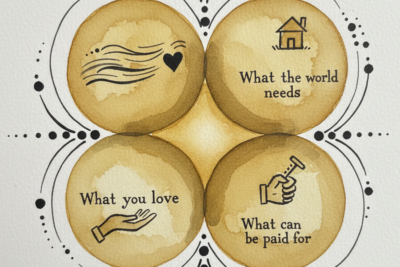
In 2011, Spanish entrepreneur Andrés Zuzunaga published a four-circle Venn diagram with the central intersection labeled "Propósito" — purpose. The four circles: what you love, what you're good at, what the world needs, what you can be paid for.
In 2014, blogger Marc Winn — inspired by a Dan Buettner TED talk about Okinawan longevity — combined Zuzunaga's diagram with the concept of ikigai and replaced "purpose" with "ikigai" in a single blog post. The post went viral.
The diagram is not Japanese in origin. It has been described by Wikipedia as an "unrealistic ideal" that is "catchy but misleading" as a representation of authentic ikigai. The creator of the original purpose diagram, Zuzunaga, has written about this distinction himself.
This isn't a scandal. The diagram is a genuinely useful tool — just not for what most people think it's for. It's not a map of ikigai in the traditional sense. It's a map of career purpose: a framework for finding work that sits at the intersection of personal passion, real skill, market demand, and economic sustainability.
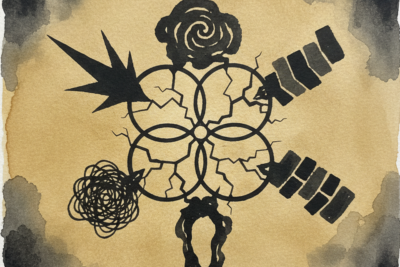
Left: traditional ikigai — a lived feeling, not a Venn diagram. Right: the Western purpose framework often mislabeled as ikigai.
Ikigai vs Purpose: What the Comparison Actually Looks Like Side by Side
| Dimension | Traditional Ikigai | Western Purpose (Venn framework) |
|---|---|---|
| Origin | Japanese (Heian period; formalized by Kamiya, 1966) | Spanish purpose diagram (Zuzunaga, 2011); relabeled by Winn, 2014 |
| Time orientation | Present — the texture of today | Forward-looking — what your career is building toward |
| Requires income? | No. A retiree's garden is valid ikigai. | Yes — one full circle is "what you can be paid for" |
| Requires grand mission? | No. Small, humble, daily things qualify. | Partly — "what the world needs" implies social contribution |
| Best used for | Daily wellbeing; sense of aliveness; mental health | Career design; finding work at the intersection of skill, love, need, pay |
| What it asks | "What makes today feel worth living?" | "What work can I do that uses me fully and creates real value?" |
| Scale | Personal; can be invisible to others | Market-facing; requires external validation (skill + need + pay) |
The practical upshot: these are complementary tools, not competing ones. Traditional ikigai is a wellbeing framework for daily life. The four-circle diagram is a career design framework for professional decisions. Using them interchangeably creates confusion. Using them together is more powerful than either alone.
Does the Distinction Actually Matter for Career Design?
Yes — because confusing them produces a specific failure mode: searching for a career that feels like it should qualify as "ikigai" by the traditional standard (small, daily, enough on its own) while also requiring it to pay well and change the world. That's the Western purpose framework's job — and it's a harder, more specific ask.
"I kept thinking my career just had to make me feel 'alive' — like ikigai promised. But then I'd dismiss options because they didn't also seem to save the world or earn well. I was applying two different standards at once without realizing it."
— Sandra, 37, marketing director, 18 months into a career redesign
Sandra's confusion was extremely common. She was using "ikigai" as the label but applying a purpose-design standard without the career-design tools. The four-circle framework is harder and more honest: it forces you to confront not just what you love, but whether what you love creates real market value and whether you've developed real skill in it.
When traditional ikigai is the right tool
Use traditional ikigai when you're trying to improve daily wellbeing, recover from burnout, or find meaning within a role that isn't perfect. It's the question to ask on a difficult Tuesday: what small thing today made this worth it? That question is answerable even if your career is misaligned. It gives you traction without demanding a full redesign.
When the four-circle framework is the right tool
Use the four-circle framework — properly understood as a purpose and career design tool — when you're making decisions about direction: which field, which role, which kind of work to build. This framework forces four questions simultaneously and won't let you optimize for just one of them. You can't build a sustainable career on love alone, or on skill alone, or on what the world needs without the economic dimension. The framework holds all four in tension at once.
How Do Ikigai and Purpose Work Together — Not Against Each Other?
The most useful synthesis is this: traditional ikigai tells you if you're alive. The purpose framework tells you what you're building.
A career fully aligned with your four-circle intersection will feel like ikigai — the work will be part of what makes your day worth living. But you can't reverse-engineer that feeling by starting with the emotion and hoping the career follows. You need to start with the structured mapping — strengths, values, market need, economic sustainability — and the feeling tends to emerge from that.
"Once I stopped treating ikigai like a feeling I had to find and started treating it like a design problem with four constraints, the whole process became workable. I knew what I was solving for."
— James, 44, transitioned from management consulting to organizational strategy practice
James's reframe is the practical one. The ikigai Venn diagram — whatever you call it — works best as an engineering tool, not a philosophical one. Input your honest answers to four hard questions. Examine the intersection. Design toward it.
Which One Should You Focus On if You're Dissatisfied With Your Career?
Start with the four-circle framework — because the problem you're solving (career misalignment) is a purpose-design problem, not a daily-meaning problem. Daily meaning can be cultivated in almost any context. Career alignment requires structural diagnosis and design.
- Feeling burned out or depleted? — Traditional ikigai helps. Ask: what small thing today felt alive? Start restoring that.
- Feeling directionless, like work doesn't add up to anything? — Purpose/four-circle framework. Map your intersection.
- Wondering if you're in the wrong field entirely? — Four-circle framework, then ikigai as a check: does the mapped direction feel like daily worth, or just logic?
- In a good role but something still feels missing? — Traditional ikigai. The career may be fine; the daily texture might need repair.
The concepts complement each other precisely because they operate at different scales. One is a lens for Tuesday. One is a lens for the next decade.
Two Tools, Two Jobs — Use Them Accordingly
Ikigai and purpose are not the same concept. They were fused together by a viral blog post in 2014 — and the conflation has cost a lot of people clarity. Traditional ikigai is about the daily texture of a life worth living: humble, personal, present. The four-circle Venn diagram is a Western career-design framework that asks harder questions about skill, market need, and sustainable income.
Both are worth having. Neither replaces the other. If you're trying to design a career that doesn't hollow you out, the four-circle framework is the right starting tool — because it won't let you optimize for just one thing. And if you find the right intersection, the work itself tends to become part of what makes the day feel worth living.
That's when the two concepts stop being in tension — and start being the same experience.
Frequently Asked Questions
Is ikigai the same as life purpose?
Not exactly. Traditional Japanese ikigai refers to the small, daily sources of meaning that make life feel worth living — a morning ritual, a hobby, a relationship. It doesn't require a grand mission or income. Western "purpose," particularly as expressed in the four-circle Venn diagram, is more explicitly career-facing: it asks about market need, economic sustainability, and contribution at scale. Related, but genuinely different in scope and orientation.
Did the ikigai Venn diagram come from Japan?
No. The four-circle diagram was created by Spanish entrepreneur Andrés Zuzunaga in 2011, with "purpose" (propósito) at the center. In 2014, blogger Marc Winn adapted it and replaced "purpose" with "ikigai," inspired by a Dan Buettner TED talk about Okinawan longevity. The post went viral. Wikipedia describes the diagram as "catchy but misleading" as a representation of traditional Japanese ikigai. The diagram is a useful career-design tool — just not an authentic Japanese one.
Can you have ikigai without it being related to your career?
Yes — and this is a key difference between traditional ikigai and Western purpose. In Japan, ikigai can be raising children, tending a garden, playing music, or belonging to a community. It doesn't require professional relevance, a salary, or social impact at scale. Okinawan centenarians describe their ikigai as the small things that make each day feel meaningful — many of which are entirely unrelated to work.
Which is more useful for career design — ikigai or purpose?
The four-circle framework (commonly called ikigai but more accurately a purpose/career-design diagram) is the more precise tool for career decisions. It integrates four constraints simultaneously — love, skill, market need, and economic sustainability — and won't let you optimize for just one. Traditional ikigai is better for daily wellbeing and for checking whether a given direction feels alive in practice. Use both: the framework to design, traditional ikigai to evaluate.
Does finding your ikigai mean quitting your job?
No — and the traditional concept of ikigai makes this especially clear. Because ikigai can exist entirely outside of work, finding it doesn't automatically require a career change. The four-circle purpose framework does require honest engagement with whether your current work uses your real skills and creates real value — but even that analysis sometimes leads to role redesign rather than resignation. The output of the framework is clarity, not a default instruction to quit.
7 Ikigai Mistakes That Keep You Stuck (And How to Fix Them)
Ikigai and Longevity: What the Science Actually Says
Ikigai Japanese Philosophy: What Most People Get Wrong

Ikigai Examples: Real People, Real Careers, Real Intersections

What Is Ikigai? The Full Guide — Beyond the Diagram
Leave a Reply
Related posts