Ikigai Japanese Philosophy:
What Most People Get Wrong
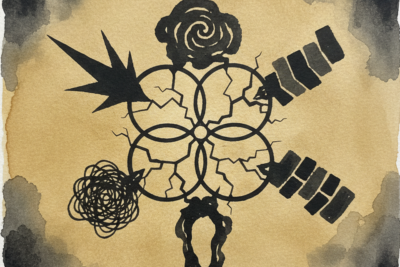
The four-circle Venn diagram you've seen everywhere wasn't created in Japan. It wasn't created by a philosopher, a psychologist, or anyone who studied ikigai. And yet it's the first thing most people encounter. The actual philosophy is older, richer, and more useful.
The ikigai Japanese philosophy has roots going back to the Heian period — over a thousand years ago. It survived centuries of social change, a world war, rapid industrialization, and a global wellness boom that, in the process, simplified it almost beyond recognition.
This article gives you the complete picture: what ikigai actually means in Japanese, where it comes from, what the viral diagram got right and wrong, and how to use it as a practical tool for career design — without flattening a nuanced philosophy into a motivational poster.
Table of contents
- What Does Ikigai Actually Mean in Japanese?
- Where Does the Ikigai Philosophy Come From?
- What Did the Famous Venn Diagram Get Wrong — and What Did It Get Right?
- What Are the Core Principles of Authentic Ikigai Philosophy?
- If the Venn Diagram Is a Simplification, Should You Still Use It?
- How Do Japanese People Actually Experience Ikigai in Daily Life?
- How Do You Apply the Ikigai Philosophy to Career Design Without Distorting It?
- The Philosophy Is Older Than the Poster
- Frequently Asked Questions
What Does Ikigai Actually Mean in Japanese?
生き甲斐
ee · key · guy
生き
iki — life · alive
+
甲斐
gai — worth · value · effect
Iki (生き) means "to live" or "being alive." Gai (甲斐) means "worth," "value," or "effect" — and according to clinical psychologist Akihiro Hasegawa, its roots may trace back to the word for "seashell" (kai), which were considered precious in ancient Japan. Together: that which makes life feel worth living.
The Oxford English Dictionary defines ikigai as "a motivating force; something or someone that gives a person a sense of purpose or a reason for living." But that definition, while accurate, is still narrower than how the concept operates in Japanese culture.
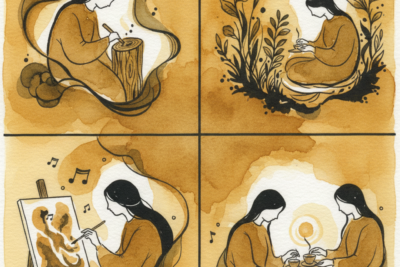
In Japan, ikigai is not confined to career. It's not a single grand mission. It can be a grandchild, a morning garden ritual, a forty-year craft, a neighborhood friendship, or a recipe passed down three generations. The breadth is the point. Ikigai is wherever you find the feeling that your life has value — not where some diagram tells you to look.
Where Does the Ikigai Philosophy Come From?
The concept has roots in the Heian period (794–1185 CE), when Japanese culture began developing a rich vocabulary for emotional and purposeful states. But it evolved continuously — through feudal Japan, the Meiji restoration, post-war reconstruction, and the economic pressures of the 20th century.
-
794–1185 CE · Heian Period
Early traces of ikigai in Japanese literary and cultural thought. Seashells (kai) were precious objects — the root of "gai" as "worth" or "value" in everyday life.
-
Edo Period · 1603–1868
Artisans, samurai, farmers, and merchants found purpose within social roles and craftsmanship. Ikigai was embedded in duty and mastery, not individual ambition. Purpose flowed through one's place in community.
-
1966 · Mieko Kamiya
Japanese psychiatrist Mieko Kamiya publishes Ikigai-ni-tsuite (On the Meaning of Life) — the first systematic academic treatment of ikigai. She frames it as similar to happiness but oriented toward the future: a force that allows people to endure imperfect present conditions.
-
2010 · Dan Buettner & Blue Zones
National Geographic reporter Dan Buettner identifies Okinawa as a longevity hotspot and attributes part of this to the residents' sense of ikigai. Western awareness begins.
-
2014 · The Diagram That Wasn't Ikigai
British blogger Marc Winn combines a purpose diagram by Spanish astrologer Andrés Zuzunaga with the word "ikigai." The post goes viral. The Venn diagram is not a Japanese invention — it was retrofitted onto the concept and later included in García and Miralles' bestselling book.
-
2016–present · Global Phenomenon
Héctor García and Francesc Miralles publish Ikigai: The Japanese Secret to a Long and Happy Life. Translated into 63 languages, 3+ million copies sold. Ikigai becomes a global concept — and the four-circle diagram becomes inseparable from it in the Western imagination.
What Did the Famous Venn Diagram Get Wrong — and What Did It Get Right?
This is the most important thing to understand about the ikigai philosophy as it's usually presented: the four-circle diagram was not created in Japan.
The original diagram was created by Spanish astrologer Andrés Zuzunaga as a "theory of purpose." In 2014, Marc Winn — a British blogger — overlaid the word "ikigai" on it and published a post that went viral. García and Miralles then included it in their bestselling book. Japanese neuroscientist Ken Mogi, author of The Little Book of Ikigai, has clarified: even unpaid activities — a love of painting, a badly-played guitar — count fully as ikigai. The "paid for" circle is a Western addition.
| ❌ What the Venn diagram gets wrong | ✓ What authentic ikigai actually says |
|---|---|
| Ikigai must be career-related | Ikigai can be anything — a relationship, a craft, a daily ritual |
| You must be paid for your ikigai | Income is irrelevant to ikigai; purpose doesn't require a paycheck |
| Ikigai is a single grand mission to "discover" | Ikigai is often small, ordinary, and plural — not one secret destiny |
| Ikigai is individual self-actualization | Ikigai is deeply communal — it grows through relationships and contribution |
| Ikigai is a static intersection to find | Ikigai evolves across life stages; it is discovered through action, not reflection alone |
So why does any of this matter? Because if you approach ikigai as "the intersection of what you love, what you're good at, what the world needs, and what you can be paid for" — and then feel stuck because nothing perfectly intersects — you're not failing at ikigai. You're failing at a diagram that was never designed as a Japanese philosophical tool in the first place.
"I spent two years trying to 'find my ikigai' using the Venn diagram. I kept thinking the circles weren't overlapping enough. Then I read Kamiya's actual framework and realized I'd been asking the wrong questions entirely."
— Elena, 41, product director, now using ikigai as a design tool rather than a destiny map
What Are the Core Principles of Authentic Ikigai Philosophy?
Stripped of the Western career-design overlay, the ikigai Japanese philosophy rests on several principles that are substantially more grounded — and more applicable to daily life — than the Venn diagram suggests.
🌱
Small over grand
Ikigai is found in everyday moments, not peak achievements. The morning coffee, the colleague you trust, the problem you enjoy solving.
🤝
Community over self
Japanese culture frames ikigai as relational. Purpose emerges from contribution and belonging, not individual self-assertion.
🎋
Action over discovery
Ikigai is created through doing, not uncovered through introspection. You don't find your purpose — you build it by showing up.
🔄
Evolving over fixed
Ikigai shifts across life stages. What gives life meaning at 30 is different from what matters at 55. The philosophy accommodates this — the diagram doesn't.
⏳
Present-anchored
Kamiya described ikigai as forward-looking enough to endure a difficult present. It is not escapism — it's a reason to show up today.
🎯
Mastery without monetization
Pursuing something you may never master — a language, an instrument, a sport — is fully valid as ikigai, even without external reward.
1.55×
Greater risk of functional decline for people aged 65+ who work only for financial reasons compared to those who work in pursuit of ikigai, according to a Japanese government-cited study. The evidence base for purpose-driven life is not self-help — it's longitudinal health research.
If the Venn Diagram Is a Simplification, Should You Still Use It?
Yes — with appropriate expectations.
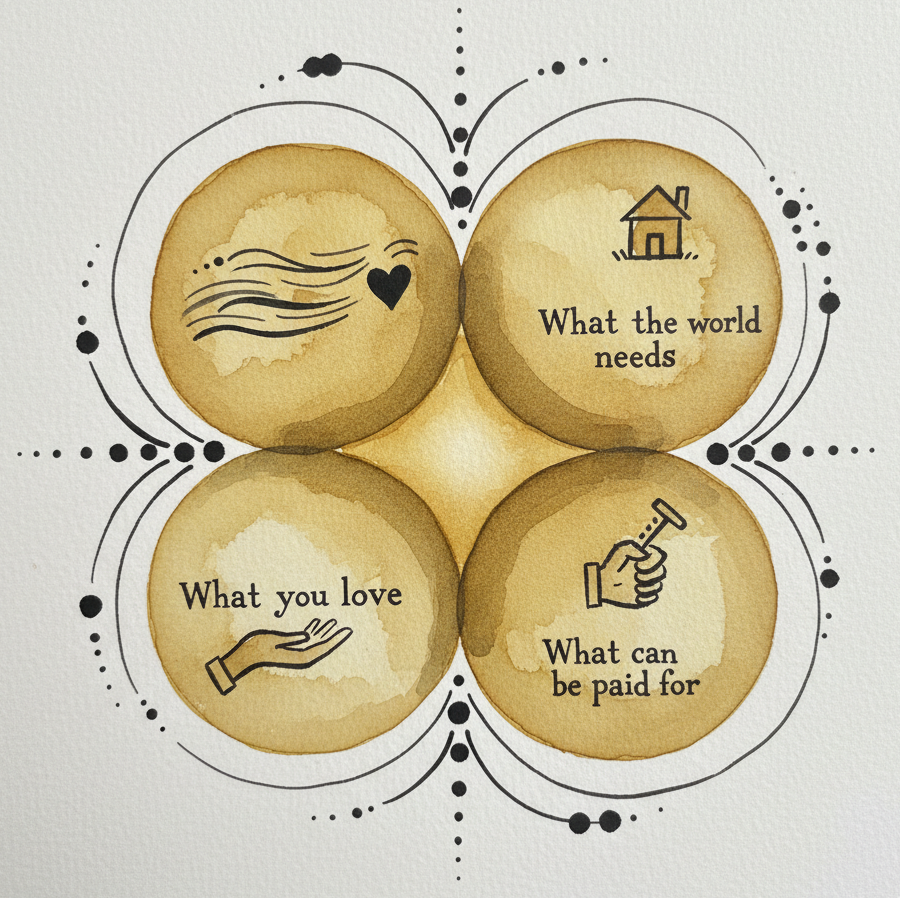
The four-circle framework (what you love / what you're good at / what the world needs / what you can be paid for) is not authentic ikigai. But as a practical Western tool for career mapping, it is genuinely useful — precisely because it forces you to think across four dimensions simultaneously, rather than optimizing for just one.
Most career decisions are made inside a single circle: take the job that pays the most (circle 4), follow the passion regardless of market demand (circle 2), or default to what you're already skilled at (circle 1). The diagram's value is not as a destiny map — it's as a diagnostic tool that surfaces which circles are missing from your current work.
The outer circles reflect the Western adaptation. Authentic ikigai doesn't require the "paid for" dimension — but for career design, all four are worth mapping.
The way to use it honestly: treat the four circles as diagnostic questions, not as criteria you must simultaneously satisfy before you're allowed to feel purposeful. Ask which circles are underrepresented in your current work. That gap is where the dissatisfaction lives.
How Do Japanese People Actually Experience Ikigai in Daily Life?
The research from Okinawa — one of the world's documented longevity zones — offers the clearest picture. When researchers asked elderly residents to name their ikigai, they didn't describe grand missions or intersection diagrams. Héctor García reports they gave answers like: my friends. Gardening. Art. Karaoke on Thursdays.
These weren't people optimizing for purpose. They were people who had found enough daily reasons to get out of bed — and that accumulation of small, specific meaning was what kept them alive and engaged well into their nineties and beyond.
"My grandmother in Kyoto has never heard of the Venn diagram. She has an ikigai: her persimmon tree, her Thursday craft group, and making sure her grandchildren eat properly. She is 94."
— Yuki T., shared in an ikigai community forum
This is what gets lost in the Western career-design version: ikigai is not a problem to solve once and then have solved. It's a quality of daily engagement that is renewed through participation — in work, in relationships, in craft, in community. The philosophy is less about finding the right answer and more about staying connected to what makes a particular day feel worth having lived.
How Do You Apply the Ikigai Philosophy to Career Design Without Distorting It?
The honest synthesis: the authentic Japanese philosophy gives you the why. The four-circle framework gives you one how. Both have value when used appropriately.
Start with the authentic question
Before any career framework: what are the moments in your current or past work that made you feel like you were actually living, not just performing? These don't have to be grand or well-paid. They're data points about where your ikigai already lives — you just haven't mapped it yet.
Use the four circles as a diagnostic, not a destination
Run through each circle specifically, not abstractly. Not "what do I love" but "what specific tasks, interactions, or problems engage me past the point where I notice time?" Not "what am I good at" but "what do people consistently ask me to do or come back to me for?" Specificity is where the diagram becomes useful.
Respect the communal dimension
The authentic philosophy places community at the center of ikigai. In career terms: who benefits from your work? Do you have any visibility to that benefit? If the answer is "nobody, because I can't trace my work to any human outcome," that's a meaning gap — not a passion problem.
Accept that it evolves
Ikigai at 30 is not ikigai at 50. The philosophy doesn't promise a permanent answer — it promises a framework for re-asking the question at each stage of life with honesty and without panic. Career transitions are not failures of purpose. They're often the most alive moments in a working life.
The Philosophy Is Older Than the Poster
The ikigai Japanese philosophy is not a diagram. It's not a formula for the perfect career. It's a way of paying attention to what makes life feel worth living — a practice that has been central to Japanese culture for over a millennium, in forms as varied as the people who hold it.
The four-circle framework that went viral is a useful adaptation. It's not wrong to use it — but it's worth knowing what it is: a Western career tool grafted onto an ancient concept that was always bigger than any single diagram. Using both honestly means respecting what the philosophy actually says while applying what the framework practically offers.
The question the authentic philosophy asks is simpler and harder than the diagram: what, today, made you feel that being alive was worth it? Start there.
Frequently Asked Questions
What is the real meaning of ikigai in Japanese?
Ikigai (生き甲斐) combines iki (生き, "life" or "alive") and gai (甲斐, "worth" or "value"). Together: that which makes life feel worth living. In Japanese culture this is broader than career or mission — it includes relationships, craft, daily rituals, community belonging, and small pleasures. The Oxford English Dictionary defines it as "a motivating force; something or someone that gives a person a sense of purpose or a reason for living."
Did the four-circle Venn diagram come from Japan?
No. The four-circle diagram was created by Spanish astrologer Andrés Zuzunaga as a "theory of purpose." In 2014, British blogger Marc Winn overlaid the word "ikigai" on it in a viral post. García and Miralles later included it in their bestselling book. Japanese authors and researchers — including neuroscientist Ken Mogi — have clarified that the diagram, particularly the "paid for" circle, does not represent authentic Japanese ikigai.
How does ikigai relate to longevity in Okinawa?
Okinawa is one of the world's documented longevity zones. Researchers including Dan Buettner (Blue Zones) and Héctor García found that its elderly residents typically have a clear sense of what makes their lives worth living — their friends, their gardens, their crafts — and remain actively engaged in these things well into old age. Japanese studies show people who work for purpose rather than only for income have a 1.55 times lower risk of functional decline. The connection is not direct causation, but the correlation with purposeful engagement is robust.
Can ikigai be applied to career design even if it's not originally about careers?
Yes — with an honest framing. The authentic philosophy isn't exclusively about work, but work takes up a significant portion of most adult lives. Applying ikigai to career design means asking which dimensions of the authentic concept — love, mastery, contribution, community — are present or absent in your daily work. The four-circle framework is a useful diagnostic for this, provided you treat it as a mapping tool rather than a formula for finding one correct answer.
Who first wrote seriously about ikigai as a philosophy?
Japanese psychiatrist Mieko Kamiya published the first major academic treatment — Ikigai-ni-tsuite (On the Meaning of Life) — in 1966. She framed ikigai as distinct from happiness: it is future-oriented, a force that allows people to endure difficult present conditions by remaining connected to something worth living for. Her work has never been translated into English, which partly explains why the Western understanding of ikigai skipped its most rigorous foundation.
7 Ikigai Mistakes That Keep You Stuck (And How to Fix Them)
Ikigai and Longevity: What the Science Actually Says
Ikigai vs Purpose: They're Not the Same Thing
Ikigai Examples: Real People, Real Careers, Real Intersections

What Is Ikigai? The Full Guide — Beyond the Diagram
Leave a Reply
Related posts