

7 Ikigai Mistakes That Keep You Stuck
(And How to Fix Each One)
Ikigai is one of the most searched career frameworks on the internet. It's also one of the most misapplied. The concept itself isn't broken — but the way most people use it is.
If you've tried the four-circle exercise and ended up more confused than before — or filled in all four circles and still had no idea what to do next — you're not alone, and you're not bad at self-reflection. You ran into one of the most common ikigai mistakes, and this article names them all.
Seven mistakes. Seven fixes. No motivation speeches. Just the specific things that cause the framework to break down — and exactly what to do differently.
Table of contents
Why Ikigai Breaks Down for So Many People
Before the mistakes: a quick note on where they come from.
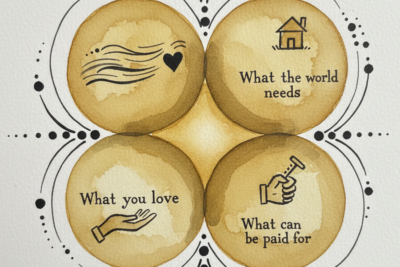
The four-circle Venn diagram most people call "ikigai" was not created in Japan. It was built by Spanish astrologer Andrés Zuzunaga as a "Purpose" diagram, then adapted by British blogger Marc Winn in a 2014 post where he replaced the word "purpose" with "ikigai." That post went viral. The real Japanese concept of ikigai is broader and simpler: it refers to multiple small things that make life feel worth living — relationships, craft, daily rituals, not just career.
None of that makes the four-circle framework useless. Used correctly, it's an excellent career design tool. The problem is that people apply it with assumptions baked in — assumptions that the original diagram doesn't actually contain, but the internet has attached to it.
Those assumptions are the source of most ikigai mistakes.
90%
of Japanese survey respondents say ikigai moments are important to life — yet the average person named 8–9 separate sources of ikigai, per a 2025 Sony Life Insurance nationwide study. Not one. Not a single perfect purpose. Eight or nine.
The 7 Most Common Ikigai Mistakes
Mistake 1
Treating the Venn Diagram as the Definition of Ikigai
The four-circle diagram is not ikigai. It's a career design tool built on top of ikigai's cultural popularity. The actual Japanese concept is about finding worth in everyday life — it doesn't require you to satisfy all four circles simultaneously, and it has nothing to do exclusively with paid work.
When people confuse the map for the territory, they create an impossible standard: everything you do must be profitable, purposeful, world-improving, and personally meaningful at once. Most things can't clear all four bars. So the exercise either produces nothing — or produces a fantasy.
The Fix
Use the four circles as a design scaffold, not a definition. You're not trying to find "the one thing" that hits all four. You're mapping your landscape: what are you skilled at? What genuinely engages you? Where is there market demand? Where do those overlap? Start there, not at the perfect intersection.
Mistake 2
Looking for One Perfect, Fixed Answer
People sit down with the ikigai diagram expecting to arrive at a single noun — "consultant," "teacher," "artist" — that they can then pursue forever. When the exercise doesn't produce that, they assume they're broken.
Japanese researchers who study ikigai have consistently found that people carry multiple sources of it simultaneously, and that those sources shift as life changes. A 2022 study of Okinawan elders — the population most associated with ikigai — showed their sources of meaning changed significantly across different life stages. Ikigai is not a tattoo. It's a compass reading that gets updated.
The Fix
Reframe the goal. You're not looking for your One True Purpose. You're looking for your current best direction — what would a well-designed next chapter look like, given who you are now? That question produces answers. "What is my ikigai?" often doesn't.
Mistake 3
Starting with "What Do I Love?" Instead of Evidence
This is the most seductive mistake. The "what do you love?" circle gets filled in first — often with things that feel right rather than things backed by any track record. Passion without evidence is just preference. Preference alone doesn't produce a viable career direction.
There's a reason Cal Newport's critique of "follow your passion" resonated with so many people: passion tends to follow mastery, not precede it. Most people love things they've gotten genuinely good at. Starting with love before you know what you're actually skilled at produces a wish list, not a plan.
The Fix
Start with "What am I genuinely good at?" — and be specific. Not job titles. Not credential categories. Name the actual skills: synthesizing complex information fast, building trust with strangers, seeing structural problems others miss. Once you have an evidence-based skills inventory, the love circle becomes much more honest to fill.
"I filled in 'creative writing' as what I love and left it at that. It took me another six months to realize I'd been good at structuring arguments since high school and that I actually loved that more. The first pass was just… what I thought I should love."
— Nadia, 31, leaving marketing, now a policy analyst
Mistake 4
Skipping the "What Does the World Need?" Circle
It's the most uncomfortable circle to fill in honestly, so most people fill it in last, quickly, and with something vague: "I want to help people." That's not an answer. That's a value statement that applies to 400 different careers.
The "world needs" circle is actually the market validation circle. It's asking: is there a real, specific, unmet need you could address? Who has that need? Are they already paying someone to address it? This is the circle that turns the exercise from a personality quiz into a career design tool. Skipping it leaves you with a beautiful map of yourself and no idea where to go.
The Fix
Spend proportionally more time on this circle than the others. Ask: what problems come up repeatedly in conversations with people I respect? What do people in my network keep struggling with that I could actually address? What's a real, specific gap — not a generality? Evidence here is everything.
Mistake 5
Treating Ikigai as a Destination Instead of a Direction
"I haven't found my ikigai yet." This is the most common sentence people use — and it reveals the most damaging assumption: that ikigai is a fixed thing you discover, like a buried object, and then possess. Once you "find" it, you're done. If you haven't found it, you haven't started.
This framing produces paralysis. People wait for clarity before acting, but clarity mostly comes from action, not from extended reflection. The ikigai framework works best as a direction-setter that you refine through experience — not a destination you must identify before moving.
The Fix
Replace "find my ikigai" with "refine my direction." You're looking for a compass heading, not an address. Make the best guess you can with the current data, take a step, observe what happens, and update the map. Ikigai is earned through iteration, not revealed through reflection.
Mistake 6
Doing the Whole Exercise Inside Your Own Head
Ikigai requires honest self-assessment — but humans are notoriously bad at accurate self-assessment in isolation. We systematically overestimate skills we're proud of and underestimate skills we take for granted. We list things we love based on what we think we should love.
The exercise done entirely alone produces a self-portrait painted from the inside, with no external calibration. The result feels true but is often significantly distorted. This is why people can spend hours on the diagram and still feel like they don't know themselves any better.
The Fix
Add at least one external input loop. Ask three people who know your work: "What do you see me doing that seems effortless for me but hard for others?" The answers will consistently surprise you — and they're usually more accurate than your own list. Treat outside observations as data, not flattery.
Mistake 7
Quitting After One Session
The ikigai exercise is typically presented as something you do once — fill in the circles, look at the intersections, discover your purpose. Most people do it once, get something vague, feel mildly inspired for a day, and then the diagram disappears into a journal or a screenshot.
That's not how the framework is designed to work. The first session produces a rough sketch. The second session, done a few weeks later with new experiences in mind, produces something sharper. The third refines it further. Purpose is built through iteration — a single session gives you hypotheses, not answers.
The Fix
Schedule at least three mapping sessions, not one. Between sessions, run small experiments: take on a project that tests a hypothesis, have a conversation that explores a direction, pay attention to what energizes and what drains. Each session should incorporate what you learned since the last. The map gets accurate through use, not through a single sit-down.
What Ikigai Looks Like — Done Wrong vs. Done Right
| Approach | ❌ Common mistake | ✓ Correct application |
|---|---|---|
| Starting point | What do I love? | What am I demonstrably skilled at? |
| Goal | Find the one perfect answer | Build a current best direction |
| "World needs" circle | "I want to help people" | Specific, named, market-validated need |
| Time frame | One session. Done. | Three+ iterations over weeks |
| Input sources | Only your own perception | Self-assessment + external feedback |
| Outcome | A mood board or an identity statement | A testable career direction hypothesis |
How Do You Know When You're Using Ikigai Correctly?
The framework is working when the output is actionable, not just emotional. If what you produce from an ikigai session is a feeling — "I feel more aligned!" — that's a positive side effect, not a result.
The result you're looking for looks like this: a specific direction with a testable next step. Not "I want to do something meaningful in sustainability." But: "I have structural problem-solving skills, the energy sector has a specific communication gap between engineers and policymakers, I've seen this close-up, and I want to explore whether I can position at that intersection."
🎯
Specific Direction
You can name a concrete next step, not just a feeling of alignment.
🔄
Iteration, Not Revelation
Each session refines the picture. Nothing feels "finished" too fast.
👁️
External Validation
Others confirm skills you identified — often ones you undervalued.
📐
Market Reality Check
You've tested whether the "world needs" circle is real, not assumed.
"The first time I did it, I got 'something in education.' The third time, I had a specific hypothesis: curriculum design for adult re-skilling programs, with a focus on people transitioning out of manual work. Those feel like very different outputs."
— Jerome, 44, former factory supervisor, now working in workforce development
The Framework Isn't Broken. The Application Usually Is.
Ikigai is a legitimate tool. It's been mispackaged, oversimplified, and over-promised — but underneath the motivational poster version is a genuinely useful way to map the intersection of your skills, values, and market reality.
The seven mistakes above are all fixable. None of them require you to start over or abandon the framework. They require you to use it with more precision: start with evidence not aspiration, iterate instead of waiting for revelation, validate externally, and treat the output as a direction rather than a destination.
Which of the seven do you recognize in yourself? That answer — honestly given — is where the useful work begins.
Frequently Asked Questions
Why doesn't ikigai work for most people?
Most people apply it once, starting with "what do I love?" and expecting a single definitive answer. That produces vague aspirations rather than actionable directions. Ikigai works when applied iteratively, starting with an honest skills inventory, backed by external feedback, and validated against real market needs. Done that way, it produces a testable career direction — not just a feeling of alignment.
Is the ikigai Venn diagram accurate?
Not as a representation of traditional Japanese ikigai. The four-circle diagram was adapted from a "Purpose" diagram by Spanish author Andrés Zuzunaga, then relabeled as "ikigai" by British blogger Marc Winn in 2014. It's a Western career design tool that became associated with ikigai's cultural credibility. That doesn't make the diagram useless — it makes it useful for a different, more specific purpose: career design, not life philosophy.
What's the biggest mistake people make with ikigai?
Treating it as a destination — something you "find" once and then have. The most consequential shift is understanding ikigai as a direction that you refine through experience, not a fixed answer you uncover through reflection. People who stay stuck with ikigai are usually waiting for more clarity before acting. People who progress with it act on their best current hypothesis and update as they go.
Can you have more than one ikigai?
Yes — and in the original Japanese understanding, that's expected. A 2025 nationwide survey in Japan found the average respondent named 8–9 separate sources of ikigai. The Western version compressed this into a search for one singular purpose, which creates unnecessary pressure. In practice, most people who apply the framework well end up with a primary career direction plus several supporting sources of meaning that aren't career-related at all.
How many times should you do the ikigai exercise?
At minimum three times, spaced weeks apart — with deliberate experiences between sessions to test hypotheses the previous session raised. The first session produces a rough sketch. Each subsequent one sharpens it. People who do it once and expect a finished map are setting themselves up for disappointment. The exercise is designed to converge through iteration, not arrive at truth in a single sitting.
Ikigai and Longevity: What the Science Actually Says
Ikigai Japanese Philosophy: What Most People Get Wrong

Ikigai vs Purpose: They're Not the Same Thing

Ikigai Examples: Real People, Real Careers, Real Intersections

What Is Ikigai? The Full Guide — Beyond the Diagram
Leave a Reply
Related posts