

Ikigai Examples: Real People,
Real Careers, Real Intersections
The four-circle diagram makes sense in theory. What's hard is seeing how it actually applies to a real person with a real career, real constraints, and no obvious "passion-meets-vocation" epiphany.
Most ikigai examples online are either celebrities — athletes, conservationists, famous monks — or job descriptions so generic they're useless. "A teacher's ikigai is educating young minds." That's not an ikigai map. That's a LinkedIn summary.
This article shows seven examples of ikigai applied to real professional profiles: the four-circle breakdown filled in for each, the intersection named precisely, and the tension that exists when one or two circles are underdeveloped. Use them as reference points while mapping your own.
Table of contents
- What the Four Circles Actually Ask — Before the Examples
- Seven Ikigai Examples Across Real Career Profiles
- What Makes a Good Ikigai Example — and What Most Lists Get Wrong
- How to Start Mapping Your Own Ikigai (Without Overthinking Circle #1)
- The Example That Matters Is Yours
- Frequently Asked Questions
What the Four Circles Actually Ask — Before the Examples
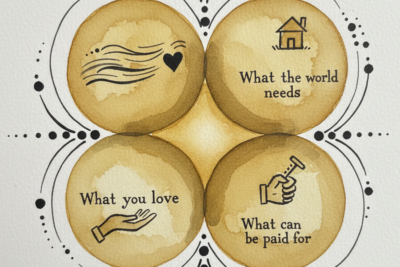
Each example in this article maps the same four questions. Before reading them, get the questions sharp in your head — because the examples only make sense if you know what each circle is actually measuring.
❤️
What you love
What activities make you lose track of time? What could you do for hours without external reward?
⚡
What you're good at
Not just what you're trained in — what do you do that comes unnaturally easy to you but is hard for others?
🌍
What the world needs
What problem do you solve? Whose life is concretely better because of what you do?
💰
What you can be paid for
Where is there demonstrated, real-world demand for what you offer — not just theoretical interest?
The intersection of all four is what ikigai aims at. But most people, when they first map it, find they're strong in two or three circles and weak in one. The examples below show exactly where those gaps tend to appear — and what happens when they're left unaddressed.
Seven Ikigai Examples Across Real Career Profiles
These are composite profiles built from common patterns across working professionals. The names are illustrative. The tensions are real.
1
The Data Analyst Who Wants to Teach
Software / Analytics · 8 years experience
❤️ Loves
Breaking complex problems into clear stories. Explaining things to non-technical people. Mentoring junior analysts.
⚡ Good at
Translating data into decisions. SQL, visualization, stakeholder communication. Making the invisible visible.
🌍 World needs
Organizations that make evidence-based decisions. Teams where junior analysts can grow quickly without wasted years.
💰 Paid for
Analytics consulting, corporate training, fractional data leadership, technical content. High demand, underserved market.
Intersection
Teaching data thinking to non-technical decision-makers — as internal lead, external trainer, or independent educator. The gap isn't talent; it's that his current role only uses the technical half.
2
The Lawyer Who Became a Mediator
Legal · 12 years at a litigation firm
❤️ Loves
Finding the version of a conflict where both sides feel heard. Listening between the lines. Helping people move past stuck positions.
⚡ Good at
Reading the emotional dynamics beneath legal arguments. Keeping conversations from escalating. Spotting common ground under stated positions.
🌍 World needs
Faster, cheaper, less destructive conflict resolution. Businesses that can settle disputes without multi-year litigation.
💰 Paid for
Commercial mediation, workplace conflict consulting, executive facilitation. Growing field with credentialing infrastructure.
Intersection
Commercial mediator specializing in corporate disputes. All four circles align — the tension was that litigation paid more initially, keeping her in a role that used her skills but worked against her values every day.
3
The Marketing Manager Who Builds Communities
B2B SaaS · 6 years brand and content
❤️ Loves
Building the feeling of belonging. Designing spaces — physical or digital — where people feel less alone in their work.
⚡ Good at
Community architecture. Knowing intuitively which content brings people together vs. which broadcasts at them. Tone-matching at scale.
🌍 World needs
Remote teams that stay cohesive. Product communities that create genuine belonging, not just user funnels.
💰 Paid for
Head of Community roles, community-led growth consulting, developer advocacy. One of the fastest-growing job categories in tech.
Intersection
Community-led growth lead at a product company. Her current title says marketing — the work says something different. The ikigai is already there; the title and job description haven't caught up yet.
4
The Finance Director with an Environmental Tension
Corporate Finance · 15 years, oil & gas sector
❤️ Loves
Complex capital allocation problems. Working at the strategic level where financial decisions determine what gets built.
⚡ Good at
Financial modeling at scale. Long-horizon scenario planning. Building board-level credibility for large capital decisions.
🌍 World needs
Financial leadership in the energy transition. Infrastructure projects that require exactly his skill set — but built for different outcomes.
💰 Paid for
CFO roles at renewable energy developers, infrastructure funds, green infrastructure project finance. Sector paying premiums for his exact experience.
Intersection
CFO of a renewable infrastructure developer. The work is identical — the context resolves the values tension. This is a same-skills, different-sector pivot. His ikigai was always there; the sector was wrong.
5
The Therapist Who Wants to Build Products
Clinical Psychology · Private practice, 9 years
❤️ Loves
Designing frameworks that create insight. Systematizing what works so more people can access it than one-to-one sessions allow.
⚡ Good at
Translating clinical insight into accessible language. Pattern recognition across hundreds of client stories. Behavior change design.
🌍 World needs
Mental health tools that scale beyond individual sessions. Products built on genuine clinical understanding, not wellness aesthetics.
💰 Paid for
Clinical advisory at mental health tech companies, digital therapeutics design, content and curriculum for wellness platforms.
Intersection
Clinical lead or product advisor at a mental health tech company — where her pattern recognition and clinical credibility translate into products that reach thousands, not fifty. One-to-one was always a constraint, not her ikigai.
6
The Operations Manager Who Wants to Write
Logistics / Operations · 10 years
❤️ Loves
Writing clearly about how complex systems work. Making operational knowledge accessible to people who build things.
⚡ Good at
Seeing inefficiency before it's visible to others. Writing internal documentation that people actually use. Simplifying without losing precision.
🌍 World needs
Operations knowledge that isn't trapped inside companies. Founders and small teams who can't afford to learn it the hard way.
💰 Paid for
Technical writing, operations consulting, newsletter monetization, fractional COO work. Multiple adjacent revenue paths.
Intersection
Operations writer and fractional COO — translating a decade of systems knowledge into written frameworks and direct consulting. The "what" circle was always writing; the "paid for" circle needed mapping, not hoping.
7
The Engineer Who Wants to Work on Climate
Software Engineering · 7 years, fintech
❤️ Loves
Building systems that matter. Problems where the stakes are real and the feedback loop is longer than a quarterly target.
⚡ Good at
Backend systems design. Building for scale under constraint. Working with messy, real-world data rather than clean datasets.
🌍 World needs
Climate tech infrastructure. Grid management systems, carbon accounting platforms, energy monitoring — all desperately under-built.
💰 Paid for
Climate tech startups, utility software, energy data platforms. Sector growing fast with genuine talent shortage at his experience level.
Intersection
Senior backend engineer at a climate tech company — same skills, different problem domain, higher stakes, stronger pull to get up in the morning. The technical work is identical. The meaning is completely different.
What Makes a Good Ikigai Example — and What Most Lists Get Wrong
The examples above share something the celebrity versions don't: they show the specific intersection, not just the general category. "A teacher's purpose is education" tells you nothing. "A former software engineer whose ikigai is teaching data thinking to non-technical decision-makers at organizations that have data but can't use it" tells you something you can act on.
The most common mistake people make when trying to find their own ikigai is treating one strong circle as a substitute for all four.
| The mistake | What it feels like | What's actually missing |
|---|---|---|
| One circle only "I love writing, so writing is my ikigai" |
Passion without direction. Fulfilling until the bills arrive. | No "world needs" specificity, no "paid for" path mapped. |
| Competence trap "I'm really good at this, so it must be right" |
High performance, low engagement. Sunday dread despite impressive outputs. | "What you love" circle almost empty. Competence ≠ purpose. |
| Mission without market "The world really needs this" |
Motivation without sustainability. Burnout within two years. | "Paid for" circle undeveloped. Noble cause, no revenue model. |
| All four, specific "I translate data for decision-makers who can't read it" |
Engaged, sustainable, financially viable, not hollow at the end of the day. | This is what the intersection looks like when it's mapped correctly. |
Most people are strong in two circles. The work is finding the specific intersection of all four.
83%
of people who describe themselves as "passionate about their work" still report feeling unfulfilled, according to research from the Harvard Business Review's passion paradox study. Passion alone is not ikigai. Passion mapped to competence, market need, and viable income — that's ikigai.
How to Start Mapping Your Own Ikigai (Without Overthinking Circle #1)
Most people stall on "what you love" — because it sounds like it should be obvious, and when it isn't, the whole exercise collapses. Two things that help:
Start with energy, not labels. Don't ask "what are my passions?" Ask: what kinds of tasks leave you more energized than when you started? What have you done this week that you'd have done even if no one was watching? Energy is a more reliable indicator than passion, which is often a word we use to describe things we've been told we should care about.
Fill in circle two first. Most people are more honest about what they're genuinely good at than about what they love — because competence is more visible. Start with your strengths. Then ask: among the things you're good at, which ones do you find yourself drawn to even when the work is hard? That overlap is often where "what you love" actually lives.
The seven examples above all started with a mismatch between two circles — someone strong in competence but weak in meaning, or strong in passion but not in market demand. The ikigai only becomes visible when all four are on the table and the tensions between them are named.
The Example That Matters Is Yours
The seven profiles above are useful because they show the structure — how all four circles look when they're specific, and what happens when one or two are underdeveloped. But they're reference points, not templates. Your ikigai isn't a category. It's a specific intersection of your particular strengths, your particular loves, and a particular gap in the world that you could fill.
The difference between a useful ikigai map and a vague one is specificity. "I love helping people" is not a circle. "I help early-stage founders think through product decisions they're too close to see clearly" is a circle — with a named skill, a named need, and a named market.
Which of the seven examples above felt most like a starting point for you? That's usually not an accident.
Frequently Asked Questions
What is a simple example of ikigai in everyday life?
A simple example: a former software engineer who discovers their real ikigai is teaching non-technical teams how to read data. They love explaining complex things, they're genuinely skilled at it, organizations badly need it, and companies pay well for it. All four circles are present and specific. That specificity — not the category — is what makes it ikigai rather than a vague "passion for tech."
Can your ikigai change over time?
Yes, and it's expected to. What you love at 28 and what you love at 42 are often quite different — not because you changed your mind, but because you've accumulated evidence about what genuinely engages you versus what you thought would. What the world needs also shifts. Ikigai is a living map, not a single destination. Revisiting it every few years, or whenever you feel misaligned, is part of the practice.
Does ikigai have to be about your career?
In its original Japanese sense, ikigai is broader than career — it includes family, community, relationships, and daily rituals. The four-circle framework with the "paid for" dimension is a westernized adaptation designed specifically for career design. For the purpose of finding work that doesn't drain you, the career-focused version is the more useful tool. The broader concept is worth understanding as context, but it won't help you redesign a career on its own.
What if I'm good at something I don't love?
This is one of the most common patterns in ikigai mapping, and it's actually a useful entry point. Being highly competent at something you don't love tells you where your skills are — not where your ikigai is. The question to ask is: within your competence area, what specific application of those skills do you find yourself drawn to? Usually there's an intersection between what you're good at and what genuinely pulls you. That's where the "love" circle starts to fill in.
How specific does an ikigai example need to be to be useful?
Specific enough to generate a decision. "I want meaningful work" is not specific enough. "I want to use my skills in financial modeling to help climate infrastructure projects get funded" is specific — it names a skill, a sector, a problem, and a market. That level of specificity is what allows you to take a concrete next action: find companies doing that, identify roles that fit, reach out to people already in that space. Vague ikigai produces vague next steps. Specific ikigai produces a plan.
7 Ikigai Mistakes That Keep You Stuck (And How to Fix Them)

Ikigai and Longevity: What the Science Actually Says
Ikigai Japanese Philosophy: What Most People Get Wrong

Ikigai vs Purpose: They're Not the Same Thing

What Is Ikigai? The Full Guide — Beyond the Diagram
Leave a Reply
Related posts