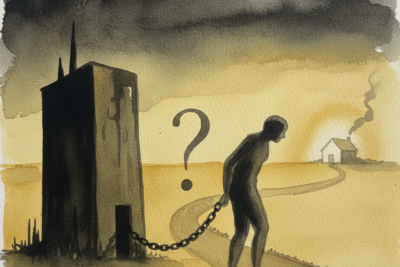

The "Is This It?" Feeling
in Your Career — Explained
You got the promotion. Or the title. Or the salary you were aiming at for years. And then — somewhere between the congratulations and the first week back at your desk — a quiet question surfaced: is this it?
If you've had that moment, you know how disorienting it is. Nothing went wrong. You succeeded. And yet the feeling arrived anyway — a kind of low-grade deflation that nobody warned you about and that's oddly hard to explain to anyone who hasn't felt it.
The "is this it?" feeling in your career is not a crisis. It's not ingratitude. It's not depression. It's a very specific signal — and this article names exactly what it is, why it arrives when it does, and what it's actually pointing toward.
Table of contents
- What Is the "Is This It?" Feeling — and Why Does It Hit After Success?
- Is the "Is This It?" Career Feeling Normal — or Is Something Wrong?
- Why Does a Successful Career Feel Hollow? The Three Phases
- Three Ways People Misread This Feeling — and Why Each One Makes It Worse
- What Is the "Is This It?" Feeling Actually Pointing At?
- How Does Ikigai Help With the "Is This It?" Feeling?
- What Comes After the "Is This It?" Moment?
- The Question Is the Starting Point, Not the Crisis
- Frequently Asked Questions
What Is the "Is This It?" Feeling — and Why Does It Hit After Success?
Psychologists have a name for what you're experiencing: the arrival fallacy. The term was popularized by Harvard professor Tal Ben-Shahar to describe the mistaken belief that reaching a goal will deliver lasting satisfaction — and the specific deflation that follows when it doesn't.
The arrival fallacy doesn't announce itself during the climb. It waits. You're too busy working toward the goal to notice the assumption embedded in the pursuit: that this — the promotion, the milestone, the number in your bank account — will be the thing that makes the effort feel worth it.
And then you arrive. And the satisfaction is real, but it's brief. Within weeks — sometimes days — the baseline reasserts itself. The goal that felt enormous is now just the new normal. And the question surfaces: what exactly was all of that for?
85%
of people report that achieving a long-sought goal brought less happiness than expected, according to research on hedonic adaptation compiled by Harvard Business Review. The "is this it?" moment is not an aberration — it's the predictable result of chasing external markers of success without an internal map of meaning.
This is why the feeling tends to arrive after success, not failure. Failure gives you a clear explanation for your dissatisfaction. Success removes every external excuse — and exposes the actual gap underneath.
Is the "Is This It?" Career Feeling Normal — or Is Something Wrong?
It's normal. It's also worth taking seriously — because "normal" and "fine to ignore" are different things.
The feeling is common enough that it has multiple names: the arrival fallacy, post-achievement emptiness, career comedown, the summit problem. It appears across professions, across income levels, across age groups. It tends to cluster around specific moments: first major promotion, hitting a decade in a field, reaching a salary target, surviving a major project, or simply looking up from the grind of execution to ask where exactly you're executing toward.
"I'd spent eight years becoming the person I thought I wanted to be professionally. And when I finally got there — I remember sitting in my new office and thinking: now what? It felt like the credits had rolled and nobody had told me there was a second act."
— Dominic, 41, senior partner at a management consulting firm
Dominic wasn't burned out. He wasn't failing. He was, by every external measure, successful. The question wasn't "what went wrong" — it was "what comes next when nothing is technically wrong but something still feels missing?"
Why Does a Successful Career Feel Hollow? The Three Phases
The "is this it?" feeling follows a recognizable structure. Understanding the three phases makes it easier to see where you are — and what's actually needed.
The feeling arrives in Phase 3 — not because something went wrong, but because the goal that drove Phase 1 and 2 never contained the meaning you were looking for.
Phase 1: The Climb — progress as a substitute for meaning
During the climb, forward motion feels like meaning. Every promotion, every new responsibility, every salary increase registers as proof that the effort is worth it. The goal is always ahead — and always just reachable enough to sustain the pursuit.
This phase is energizing precisely because it's oriented. You know what success looks like. The target is specific and external. The feedback loop is clear.
Phase 2: The Summit — the arrival and its brief warmth
The achievement lands. There's genuine satisfaction, real recognition, a moment of arrival. This is real — not imaginary. The problem is that it's brief. The nervous system resets within weeks. The achievement becomes the new baseline. The summit stops being a summit and becomes just the floor of the next section.
Phase 3: The Question — when the old map runs out
This is where the "is this it?" feeling lives. The original goal has been reached. The map that governed Phase 1 and 2 — get the promotion, hit the number, earn the title — has no more territory to cover. The disorientation isn't failure. It's the end of a map that was never designed to take you anywhere beyond this point.
Three Ways People Misread This Feeling — and Why Each One Makes It Worse
The "is this it?" feeling is almost always misdiagnosed. The misdiagnosis drives the wrong response. Here are the three most common misreadings and what's actually true instead.
😔
Misreading #1: "I'm ungrateful"
Gratitude is real and valuable. But confusing it with career meaning keeps you performing contentment you don't feel — and delays the honest reckoning.
🔥
Misreading #2: "I'm burned out"
Burnout is depletion from overexertion. The "is this it?" feeling can arrive when you're well-rested. The cause is misalignment — not volume.
🌀
Misreading #3: "I just need a new challenge"
A harder goal in the same direction won't fix it. The issue isn't difficulty — it's direction. More climbing on the same ladder doesn't address the question of which wall it's leaning against.
Each of these misreadings sends you in the wrong direction. Gratitude practice won't resolve a direction problem. Rest won't fix a misalignment problem. A new stretch goal won't answer a meaning problem.
The right response to the "is this it?" feeling isn't to silence it or outrun it. It's to use it as data — which means first understanding what it's actually measuring.
"I tried three things in sequence: I told myself to be more grateful, I took a sabbatical, and then I went after an even bigger role. None of it touched the actual feeling. It wasn't until I stopped trying to make it go away that I could hear what it was saying."
— Yael, 44, chief marketing officer, now founder of a B Corp consultancy
What Is the "Is This It?" Feeling Actually Pointing At?
At its core, it's pointing at a gap between what you've optimized for and who you actually are.
Most career paths are built around external metrics: salary, title, prestige, institutional recognition. These are not bad things. But they're measuring outputs — not alignment. And you can hit every output target while drifting further from the kind of work that would actually engage you.
The feeling is the gap registering. Not as depression. Not as failure. As a question that deserves an honest answer.
The question underneath "is this it?" is almost always one of three things:
- Am I using my actual strengths? Or the ones that got credentialed, hired, and promoted — which may be a different set entirely.
- Does this work connect to anything that matters to me? Not the company's mission statement. What actually matters to you.
- Who decided this was the destination? And was that person operating from your values — or from someone else's definition of success?
How Does Ikigai Help With the "Is This It?" Feeling?
Ikigai — the Japanese concept meaning "reason for being" — is useful here not as inspiration, but as a diagnostic instrument. It asks four questions that most career planning frameworks completely ignore:
The "is this it?" feeling usually means you've optimized for the bottom two circles — and neglected the top two entirely.
Most careers that produce the "is this it?" feeling have been built almost entirely inside the bottom two circles: competence and income. Both are real and important. But meaning doesn't live there. It lives at the intersection — and specifically in the top half of the diagram, where what you love and what the world needs actually overlap with what you do.
Working through the ikigai framework isn't a journaling exercise. It's a structured audit: what are your actual strengths (not just your credentialed ones)? What engages you in the rare moments it does? Where does your market have a gap you could fill in a way that aligns with those things? What would a role at the intersection actually look like?
What Comes After the "Is This It?" Moment?
Two things can follow — and the difference between them is whether the question gets answered or suppressed.
If suppressed: the slow drift
Most people suppress it. They take on a bigger project, pursue a lateral move, throw themselves back into execution. The question goes quiet. But it doesn't disappear. It reappears — louder — at the next milestone, and the one after that. Each cycle costs a little more.
If answered: the reorientation
Answering it doesn't require an immediate dramatic change. It requires honesty — specifically, honesty about what your strengths actually are, what your work is actually missing, and what a different kind of career might actually look like for someone with your specific profile.
The reorientation is usually quieter than people expect. It often doesn't mean quitting. It means redesigning — sometimes from within the same organization, sometimes in a new direction — with a map you now have that you didn't have before.
"I didn't leave my company. I redesigned my role inside it — moved from operational leadership into strategic advisory work, which was what I was actually good at and cared about. The 'is this it?' feeling was pointing at the mismatch, not at the organization."
— Camille, 46, VP of Operations turned internal strategy lead at a global FMCG company
The Question Is the Starting Point, Not the Crisis
The "is this it?" feeling in your career is not a sign that something has gone wrong. It's a sign that the map you've been using — the one that was built around promotions, salary targets, and external milestones — has reached its edge. It wasn't a bad map for the climb. But the climb was never the destination.
The feeling surfaces because your nervous system has already registered what your conscious mind hasn't caught up to yet: that the work you're doing and who you actually are are not the same thing. The dissonance between those two is what "is this it?" sounds like.
The question isn't a problem to solve. It's an invitation to map what comes next — this time, from the inside out. What would you build if the goal was alignment, not just advancement?
Frequently Asked Questions
Why do I feel like "is this it?" after achieving my career goals?
Because the goals were real, but they were measuring the wrong thing. External milestones — promotions, salary targets, titles — create a forward-oriented energy during the pursuit. But they don't contain meaning in themselves. When you arrive, the goal stops generating that energy and the underlying gap between your work and who you are becomes visible. The feeling arrives after success, not despite it.
Is the "is this it?" career feeling the same as burnout?
No — they're distinct. Burnout is depletion from sustained overexertion. The "is this it?" feeling can arrive when you're fully rested, performing well, and externally successful. The cause is different: burnout is about volume and exhaustion; the arrival hollowness is about direction and misalignment. They can coexist, but treating one doesn't address the other.
What does ikigai have to do with the "is this it?" feeling?
Ikigai is a diagnostic framework built around the intersection of what you love, what you're good at, what the world needs, and what you can be paid for. The "is this it?" feeling typically means your career has been built in the bottom two circles — competence and income — while the top two have been ignored. Ikigai gives you a structured way to map the full picture and identify what's actually missing.
Does the "is this it?" feeling mean I should change careers?
Not necessarily. The feeling points at misalignment — but the misalignment can sometimes be addressed within your current field or organization by redesigning the work itself. Whether a full career change is needed depends on how structural the gap is. If your core competencies and values are incompatible with the sector you're in, the change needs to be larger. If the gap is in scope or contribution type, you may be able to redesign from where you are.
How do I move forward when my career success feels hollow?
Start with diagnosis, not action. The impulse to solve the feeling immediately — with a new job, a new challenge, or a sabbatical — tends to reproduce the same pattern. The more durable path is a structured audit: what are your actual strengths, what kind of work genuinely engages you, and where does your market have unmet needs that you could address? That audit gives you a map. The map makes the next move calculated instead of reactive.
Should I Quit My Job? Answer These 5 Questions First

Career Anxiety Symptoms — And What They're Really Telling You

How to Stop Living for the Weekend — For Good

Work-Life Balance vs. Meaning: The Wrong Trade-Off

My Life Feels Empty — What That Feeling Is Pointing At

How to Know If You're in the Wrong Career (Not Just a Bad Job)
Leave a Reply
Related posts