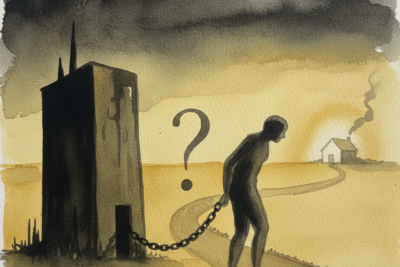

Career Anxiety Symptoms —
And What They're Actually Telling You
You recognize the symptoms. The tight chest on Sunday evening. The inability to concentrate at your desk. The procrastination that looks like laziness but feels like dread. They all have a name — but the name alone doesn't tell you what to do.
Most articles about career anxiety symptoms give you a checklist and then offer the same advice: breathe, talk to someone, set better boundaries. That's not useless — but it treats all career anxiety as the same animal. It isn't.
The same symptom — Sunday night dread, say, or persistent self-doubt — can have three completely different root causes. And the response that works for one root actively doesn't help the others. This article names the symptoms, decodes what each one is actually pointing at, and tells you what to do based on which root you find.
Table of contents
- What Are Career Anxiety Symptoms — and Why Do They Show Up?
- What Are the Most Common Career Anxiety Symptoms?
- What Do Career Anxiety Symptoms Actually Mean? The Decoder
- How Do You Tell the Difference Between Career Anxiety and Burnout?
- When Are Career Anxiety Symptoms Actually a Misalignment Signal?
- How Does Ikigai Address Career Anxiety Caused by Misalignment?
- What Should You Do Based on Which Root You Identified?
- The Symptom Is the Signal. The Signal Has a Source.
- Frequently Asked Questions
What Are Career Anxiety Symptoms — and Why Do They Show Up?
Career anxiety is not the same as work stress. Stress is acute — a deadline, a difficult conversation, a big presentation. It arrives, does its damage, and passes. Career anxiety is chronic. It doesn't resolve when the project ends. It follows you home, colors your weekends, and gets louder over time rather than quieter.
Career anxiety symptoms appear in three domains simultaneously: physical (tight chest, poor sleep, headaches), cognitive (intrusive thoughts, worst-case scenarios, inability to concentrate), and behavioral (procrastination, overwork, avoidance, social withdrawal). What most checklists don't tell you is that these symptoms are downstream of something — and that something differs by person.
44%
of workers report feeling significant work-related anxiety regularly, per the American Psychological Association's Work and Well-Being Survey. The majority do not seek professional support — partly because they're not sure whether what they're experiencing is "real" anxiety or just "normal" work stress.
That uncertainty — is this a me problem or a job problem? — is itself one of the most common symptoms. The inability to tell whether you're anxious because of who you are or because of where you are is diagnostic in its own right.
What Are the Most Common Career Anxiety Symptoms?
Here are the eight symptoms that appear most consistently across the research and in people experiencing career-related distress. They're real. They're documentable. And each one has an interpretation most articles skip.
😶
Sunday Night Dread
Anticipatory anxiety that arrives before the week begins. Body bracing for something it predicts.
🔁
Chronic Procrastination
Not laziness. Avoidance of tasks that feel threatening or pointless. Often masks something deeper.
🪞
Persistent Self-Doubt
Questioning your competence even when your track record doesn't support the doubt.
💭
Intrusive Work Thoughts
Work follows you into evenings, weekends, sleep. Your brain won't clock out.
😶🌫️
Hollowness / Emptiness
No single crisis — just a diffuse sense that nothing you do at work adds up to anything.
⚡
Irritability at Work
Low tolerance for meetings, colleagues, tasks. Disproportionate reactions to small friction.
🏃
Overwork / Proving
Compensating for hidden self-doubt by working more hours. Exhaustion that doesn't produce satisfaction.
🧱
Decision Paralysis
Unable to make career moves — too many options, none feeling right. Frozen at the crossroads.
What the standard lists don't do is decode these. Knowing you have them doesn't tell you what they're pointing at. The same symptom looks completely different depending on its root.
What Do Career Anxiety Symptoms Actually Mean? The Decoder
Career anxiety symptoms cluster around three distinct root causes. Each has a different origin, a different trajectory, and a different treatment. Most people are experiencing a combination — but one root usually dominates.
Root A — Clinical / generalized anxiety expressing through work
Anxiety disorder that uses the career as its primary surface. The workplace isn't the cause — it's the arena. Symptoms: intense, disproportionate worry; physical symptoms regardless of specific work events; anxiety present even during calm periods; history of anxiety in other life domains.
Root B — Environmental stress (the job really is the problem)
The role, manager, culture, or workload is genuinely dysfunctional. Symptoms are proportionate to real conditions. They improve during holidays or when specific stressors are removed. The anxiety is a reasonable response to an unreasonable environment.
Root C — Career misalignment (the work doesn't fit who you are)
The anxiety is a signal of structural mismatch — between the work and your strengths, values, or sense of meaning. Symptoms persist even in healthy environments. The work is technically fine but feels hollow. No amount of stress management resolves it because the source isn't stress — it's wrongness of fit.
| Symptom | If Root A (clinical) | If Root B (environment) | If Root C (misalignment) |
|---|---|---|---|
| Sunday dread | Present regardless of the job; persists across roles Clinical | Tied to specific team/manager; eases on vacation Environmental | Chronic across every role; no bad boss required Misalignment |
| Self-doubt / imposter | Global; applies to most areas of life Clinical | Triggered by unsupportive feedback culture Environmental | Specific to this role; lower in activities you actually love Misalignment |
| Procrastination | Task avoidance across all areas of life Clinical | Specific tasks linked to toxic dynamics Environmental | Work tasks only; not present in personally meaningful activities Misalignment |
| Hollowness / emptiness | May be depression co-occurring with anxiety Clinical | Rare — usually environment produces frustration, not emptiness Environmental | Signature symptom of misalignment — the meaning absence Misalignment |
| Overwork / proving | Driven by fear of judgment; anxiety disorder pattern Clinical | Driven by genuinely unrealistic demands Environmental | Compensating for lack of intrinsic meaning with external validation Misalignment |
| Irritability | Generalized arousal; present at home too Clinical | Situational; specific people or tasks; eases on days off Environmental | Frustration at doing work that uses you the wrong way, daily Misalignment |
| Intrusive work thoughts | Rumination across all topics; can't turn off Clinical | Replaying specific conflicts or fears Environmental | Obsessive questioning — "is this it for me?" — not replaying events Misalignment |
| Decision paralysis | Present in many life decisions; not career-specific Clinical | Rare in this root Environmental | Can't see a clear alternative — the fog of no map Misalignment |
"I went to therapy for two years, which helped with a lot of things — but it didn't touch the Sunday feeling. My therapist was good, but she was treating anxiety. What I actually had was the wrong job for twelve years."
— Nadia, 40, operations director, now a UX researcher
Nadia's experience is common and under-discussed. Clinical support is valuable — and sometimes necessary. But if the dominant root is misalignment, cognitive behavioral tools won't reorganize your career. They'll help you tolerate the wrong thing more gracefully. That's not nothing. But it's not the solution.
How Do You Tell the Difference Between Career Anxiety and Burnout?
These two are frequently confused, and they require different responses. The distinction matters.
Anxiety vs. Burnout — where your symptoms sit
Pure anxiety
High arousal
Racing thoughts Overlap zone
Both present Pure burnout
Depletion
Numbness
High arousal
Racing thoughts Overlap zone
Both present Pure burnout
Depletion
Numbness
Career anxiety: racing thoughts, hypervigilance, avoidance, worrying about things that haven't happened yet
Overlap: poor sleep, irritability, concentration loss, physical symptoms — can be both simultaneously
Burnout: emotional exhaustion, cynicism, reduced efficacy, flatness — the tank is empty, not buzzing
The clearest practical test: in burnout, rest helps temporarily. In anxiety, rest often amplifies the symptoms — more time to think, more catastrophizing. If you come back from a week off and feel calmer, burnout was more dominant. If you come back and the dread reassembles itself by day two, the root is anxiety or misalignment.
Both can coexist with career misalignment. Misalignment-driven anxiety, if sustained long enough without intervention, frequently produces burnout as a second layer.
When Are Career Anxiety Symptoms Actually a Misalignment Signal?
This is the question nobody in the SERP is asking — and it's the most important one for the majority of people experiencing career anxiety.
Misalignment-driven anxiety has a specific fingerprint. It passes through the decoder table above as mostly Root C symptoms. More practically, it shows up like this:
- The anxiety is role-specific. It drops significantly during hobbies, personal projects, or voluntary work — even demanding ones.
- The hollowness is present even on "good" days. You hit your targets and feel nothing. The emptiness is structural, not situational.
- You've changed companies and the feeling followed you. Different environment, same dread — because the environment was never the cause.
- The intrusive thoughts are existential, not tactical. Not "will I finish this report?" but "is this all there is?"
- Therapy and stress management provide partial relief at best. You feel better, but the fundamental dissatisfaction persists.
If four or five of those are true, the dominant root is misalignment. Coping tools will not resolve a design problem. What's needed is a redesign — of the work, the role, or the career direction.
"Every coping mechanism I tried worked while I was doing it. Meditation, exercise, journaling — all helped. But I'd close the journal and the weight was still there. It wasn't anxiety. It was wrongness."
— Tom, 35, management consultant, three years into career transition
How Does Ikigai Address Career Anxiety Caused by Misalignment?
Ikigai — a Japanese concept meaning "reason for being" — functions in this context as a diagnostic and design framework. It maps four dimensions simultaneously, and the intersection of all four is where misalignment-driven anxiety typically dissolves.
Misalignment-driven anxiety usually signals living in one or two circles, ignoring the rest.
Most careers optimize for the bottom circle (#4 — income) and the left circle (#2 — competence) while neglecting love and meaning. The symptoms of that neglect are the Root C column in the decoder above.
The ikigai mapping process doesn't tell you to quit your job. It tells you, specifically, which circles are empty and what filling them might look like — inside your current role, through a pivot, or through a full career redesign. That specificity is what makes anxiety actionable.
What Should You Do Based on Which Root You Identified?
The decoder table gives you your root. Here's the response path for each.
If Root A is dominant (clinical anxiety)
Professional mental health support is appropriate and often necessary. Cognitive behavioral therapy has strong evidence for anxiety disorders. This doesn't preclude also examining career fit — but lead with professional support rather than career design. A therapist can help you determine whether the career is contributing to, or is separate from, the clinical picture.
If Root B is dominant (environmental)
The fix is context, not identity. Changing companies, teams, or managers while keeping similar work may be enough. Before making a move, document specifically what's producing the symptoms — bad management, toxic culture, unrealistic workload. Confirm the problem is environmental (symptoms ease significantly during vacations or when specific people are absent). Then change the context.
If Root C is dominant (misalignment)
This is a design problem. The response is to map — your strengths, your values, where the market has demand you can serve, what you actually love doing — and build a concrete picture of work that fits. This process takes weeks, not days. But it's the only response that addresses the root rather than managing the symptom.
The Symptom Is the Signal. The Signal Has a Source.
Career anxiety symptoms are real, measurable, and worth taking seriously. But a symptom list — even a comprehensive one — is only useful if it points you toward the right root cause. Treating misalignment with coping tools is like taking painkiller for a fracture: the pain lessens, the fracture persists.
Run the decoder. Identify which column your symptoms cluster in. If it's Root C — if the dominant signal is hollowness, role-specific doubt, existential questioning, and anxiety that follows you across companies — you don't need more coping strategies. You need a clearer map of where you should actually be.
What would it look like if the work you spent 40 hours a week on actually matched who you are? That's not a rhetorical question. It's the design brief.
Frequently Asked Questions
What are the most common career anxiety symptoms?
The most consistent career anxiety symptoms are: Sunday night dread, chronic procrastination, persistent self-doubt, intrusive work-related thoughts, hollowness or emptiness at work, disproportionate irritability, overwork as self-proving, and decision paralysis around career moves. These appear across cognitive, physical, and behavioral dimensions — often simultaneously. Their significance depends on which root cause is driving them.
How do I know if my career anxiety is caused by misalignment vs. a real anxiety disorder?
Key differentiators: clinical anxiety tends to be global — present across life domains, not just work. Misalignment-driven anxiety tends to be role-specific — it drops during personal projects, hobbies, and meaningful activities. If you've changed companies and the same symptoms followed you, and if therapy or coping tools provide only partial relief, misalignment is likely the dominant root. A professional assessment can confirm the clinical picture.
Can career anxiety symptoms go away without changing jobs?
Yes — but it depends on the root. Environmental anxiety (Root B) can resolve with a change of team, manager, or company culture in the same field. Misalignment anxiety (Root C) can sometimes resolve with a role redesign within the same company, if the core tasks can be shifted toward your strengths and values. What doesn't work is staying in the exact same role and hoping coping strategies eliminate structural symptoms.
What's the difference between career anxiety and burnout symptoms?
Career anxiety is characterized by high arousal — racing thoughts, anticipatory dread, hypervigilance, avoidance. Burnout is characterized by depletion — emotional exhaustion, cynicism, flat affect, reduced efficacy. They can coexist. A practical test: if rest temporarily helps but symptoms return quickly, anxiety is dominant. If extended rest produces meaningful (if temporary) relief, burnout is more prominent. Misalignment can drive both sequentially.
Does ikigai help with career anxiety?
Ikigai is specifically useful for Root C — misalignment-driven anxiety. It functions as a diagnostic framework, mapping the intersection of your strengths, values, what the world needs, and what you can be paid for. By making that intersection visible, it converts vague existential anxiety into a concrete design problem with a concrete direction. It is not a substitute for professional mental health support when clinical anxiety or burnout is the dominant root.
Should I Quit My Job? Answer These 5 Questions First

How to Stop Living for the Weekend — For Good

Work-Life Balance vs. Meaning: The Wrong Trade-Off

The "Is This It?" Feeling in Your Career — Explained

My Life Feels Empty — What That Feeling Is Pointing At

How to Know If You're in the Wrong Career (Not Just a Bad Job)
Leave a Reply
Related posts