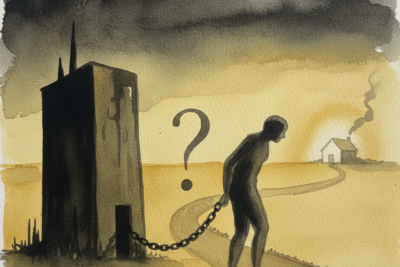

My Life Feels Empty
— What That Feeling Is Pointing At
Everything on the outside looks more or less fine. And yet something has gone quiet on the inside — not sad, exactly. Just hollow. Like the signal got turned down and you can't find the dial.
If your life feels empty, you already know this doesn't respond to standard advice. You've probably tried staying busy, filling the schedule, making plans. The hollowness is still there when things go quiet again.
This article starts with something most others skip: distinguishing the emptiness that needs clinical support from the emptiness that needs a different kind of work entirely. Then it goes deep on the second type — what causes it, how to read it, and what to actually do.
A note before we go further: Persistent emptiness can sometimes be a symptom of depression, grief, or other conditions that genuinely benefit from professional support. If your emptiness comes with loss of interest in things you used to enjoy, changes in sleep or appetite, or thoughts of self-harm, please reach out — the 988 Suicide and Crisis Lifeline (call or text 988) is free, confidential, and available 24/7. A therapist or your GP is also a good first call. This article is for people who are not in that kind of distress — but if you're unsure, professional support is always the right starting point.
Table of contents
- Why Does My Life Feel Empty? The Two Types Nobody Distinguishes
- My Life Feels Empty Even Though Nothing Is Technically Wrong — Why?
- What Actually Causes That Hollow Feeling? The Four Sources of Purpose-Emptiness
- Is Feeling Empty the Same as Having No Purpose?
- What Does It Mean When Your Life Feels Empty Despite Having Everything?
- How Do You Start Filling the Emptiness? (What Actually Works)
- The Emptiness Is the Signal, Not the Sentence
- Frequently Asked Questions
Why Does My Life Feel Empty? The Two Types Nobody Distinguishes
The phrase "my life feels empty" covers two very different experiences that require completely different responses. Mixing them up is why most advice on this topic lands flat.
| Type | What it feels like | What's driving it | What it needs |
|---|---|---|---|
| Clinical | Numbness that won't lift; loss of pleasure in things you used to enjoy; physical heaviness; persistent hopelessness | Depression, grief, burnout, trauma, BPD, or other conditions with neurological and psychological roots | Professional support — therapy, psychiatric care, grief work. Not a life design exercise. |
| Existential / Purpose | Hollow in the presence of things that "should" feel good; competent but directionless; functioning well but nothing resonates; life feels like someone else's script | Misalignment between who you actually are and the life you're living — wrong work, borrowed values, accumulated drift from your own identity | A diagnostic framework and a redesign process. Ikigai is purpose-built for this. |
These types can overlap. Someone dealing with depression also deserves a more meaningful life. But they're not the same problem, and they don't have the same solution.
This article addresses the second type — the existential emptiness that arrives when your life is objectively fine but somehow fundamentally misaligned with who you are. If you're unsure which type you're dealing with, start with a therapist. That's not a detour; that's the right sequencing.
My Life Feels Empty Even Though Nothing Is Technically Wrong — Why?
This is the version that's hardest to name and hardest to justify to other people.
You're not sick. You're not in crisis. You have things many people work their whole lives for. And you feel hollow. The hollowness is worse than sadness, in a way — at least sadness has a clear source. This is just a persistent absence.
"I kept trying to explain it to my partner and I couldn't. I wasn't depressed. I wasn't even unhappy exactly. It was like the volume on my own life had been turned all the way down."
— Sasha, 37, product director, after eight years building a career she'd once wanted badly
1 in 4
adults in the US report feeling that their daily activities lack meaning, per the Gallup Global Study on Meaning at Work. This is not a niche crisis — it's the quiet default state for a significant portion of the workforce and adult population.
What Sasha — and most people in this position — are experiencing is not a disorder. It's the predictable result of spending years optimising for external markers (career progression, stability, approval, income) while the internal ones — identity, values, purpose — went unexamined.
The emptiness is the gap between the life you've built and the life that would actually fit.
What Actually Causes That Hollow Feeling? The Four Sources of Purpose-Emptiness
Existential emptiness doesn't arrive randomly. It has specific structural causes — and identifying which one you're dealing with changes everything about what you do next.
Source 1: Wrong work
You're spending the majority of your waking hours on tasks that don't use your real abilities — the things you're genuinely good at in a way that feels almost effortless. Competence without engagement hollows you out slowly and reliably. You can perform the role fine. But nothing accumulates. No sense of having built anything that matters.
Source 2: Borrowed life script
At some point — often in your twenties — you adopted a template: good university, good company, good salary, good apartment. It was a reasonable template. It just wasn't yours. Nobody asked you what you actually wanted; the script was handed down and you followed it because it looked like success from the outside.
Now you've achieved the script. And you feel nothing in particular about it. The emptiness is the gap between completing a life that was assigned to you and not yet having designed one that is actually yours.
Source 3: Values-life misalignment
Your days are organised around things that don't reflect what you actually care about most. Maybe you care about creativity but spend your time in meetings. Maybe you care about impact but your work is internal process work that affects nothing visible. Maybe you care about depth but the culture around you rewards speed. The misalignment compounds daily.
Source 4: Identity drift
You've changed — through experience, age, relationships, failures — and the life you're living hasn't kept up. The role that fit you at 28 doesn't fit you at 38. The priorities that felt urgent at 35 feel hollow at 42. You're living in a previous version of yourself. The emptiness is the distance between who you've become and the life that still reflects who you used to be.
🔧
Wrong Work
Real abilities unused. Performing competently at something that never actually engages you.
📋
Borrowed Script
You achieved someone else's definition of a good life. Successfully.
⚖️
Values Gap
Daily life is organised around things that don't reflect what you actually care about.
🕰️
Identity Drift
You've grown. Your life hasn't caught up. You're living a previous version of yourself.
Is Feeling Empty the Same as Having No Purpose?
Close, but not identical.
Purpose is a specific thing — a clear enough sense of what you're for that it can orient your choices, your work, your attention. Emptiness is what you feel when that orientation is absent. One is the root; the other is the symptom.
What makes this confusing is that most people conflate "purpose" with some grand, singular calling. They imagine it as a moment of revelation — I was born to do this — and because they haven't had that moment, they assume the purpose doesn't exist yet.
That framing is almost always wrong. Purpose isn't discovered in a flash. It's constructed — from the specific combination of what you're genuinely good at, what actually engages you, what creates real value for people around you, and what your particular context allows you to be paid for.
The Japanese concept of ikigai maps exactly this construction. It's not a search for your destiny. It's a diagnostic exercise that finds the intersection where your specific configuration of strengths, engagement, value, and viability overlaps.
Emptiness lives in the gap between these circles. Purpose lives at their intersection.
What Does It Mean When Your Life Feels Empty Despite Having Everything?
It means you've been solving the wrong problem.
Most people spend their twenties and thirties building: the career, the savings, the relationships, the apartment. These are real achievements. But they're all in service of a question nobody explicitly asked — what do I actually want my life to be for?
The emptiness that arrives in the presence of achieved goals is your inner operating system asking that question belatedly. It's not ingratitude. It's not pathology. It's the natural result of succeeding at a game you never consciously chose to play.
"I'd hit every goal I'd set for myself by 35. And I remember sitting in my car after a perfectly good workday thinking: is this it? Not in a depressed way. In a genuinely confused, 'I seem to have finished the wrong thing' kind of way."
— Daniel, 41, senior engineer, 12 years at a company he respected but never felt part of
Daniel wasn't broken. He was finished with a version of his life that had never been examined closely enough to know if it was his. The emptiness was the first time he'd stopped moving fast enough to hear the question.
How Do You Start Filling the Emptiness? (What Actually Works)
The instinctive responses don't work. Adding more activities to a life that's already full of the wrong activities doesn't fix emptiness — it buries it temporarily. Neither does quitting everything impulsively in search of something more "meaningful."
What works is a structured sequence:
Step 1: Name which source is yours
The four sources above — wrong work, borrowed script, values gap, identity drift — are not abstract. One of them (or a combination) is specific to your situation. Before any external action, identify it precisely. "My life feels empty" is too vague to act on. "I've been living a borrowed script and my values haven't been part of my daily work in six years" is actionable.
Step 2: Map what you've actually become
Most people trying to escape emptiness look outward immediately — for a new job, a new country, a new relationship. The more productive direction is inward first: a serious inventory of what you're genuinely good at now (not what you were trained in), what actually engages you (not what sounds good), and what you care about at a values level.
Step 3: Find the intersection before you make the move
The emptiness will not be resolved by moving to a different version of the same misalignment. It requires finding the intersection of what you're genuinely good at, what actually engages you, what the world has real demand for, and what you can build income from.
That intersection is what ikigai maps. It almost always exists — but it requires honest, structured work to find. It cannot be shortcut by inspiration alone.
Step 4: Test before you transform
Once you have a mapped direction, start small. A conversation, a project, a day of working differently. The goal isn't a dramatic life overhaul on day one. It's the first concrete piece of evidence that the alternative you've mapped actually produces the feeling you're missing. Evidence reduces fear. And fear is what keeps most people in the empty life they already have.
The Emptiness Is the Signal, Not the Sentence
Feeling that your life is empty is uncomfortable. But it is not a verdict. It's a signal — your internal sense of alignment asking, for the first time or the hundredth time, whether the life you're living is actually yours.
The people who move through this well are not the ones who found a sudden answer. They're the ones who took the signal seriously enough to stop treating it as a mood to be managed — and started treating it as a design problem to be solved.
If the outside of your life is fine and the inside is hollow, the question isn't what's wrong with you. The question is: what would a life that actually fit look like? Start mapping. The answer is in the intersection, not in the inspiration.
Frequently Asked Questions
Is it normal for life to feel empty even when things are going well?
Yes — and it's more common than people admit. External success and internal alignment are separate things. You can achieve most of what you set out to achieve and still feel a persistent hollowness, because the goals were calibrated to an external standard rather than your own values and identity. Gallup research suggests around one in four adults regularly feels their daily activities lack meaning. The emptiness isn't a character flaw; it's a mismatch signal.
What's the difference between feeling empty and being depressed?
Depression typically involves a cluster of symptoms: persistent low mood, loss of pleasure in things you used to enjoy, changes in sleep or appetite, fatigue, and sometimes thoughts of self-harm. Existential emptiness is more specifically a sense of hollowness or directionlessness — functioning normally but lacking resonance or meaning. The two can overlap, and if you're unsure, a professional is the right first call. But they're not the same condition and don't require the same response.
Can ikigai help if my life feels empty?
Ikigai is specifically designed for the existential/purpose type of emptiness — the feeling that your life lacks direction or alignment, even when external conditions are okay. It works as a diagnostic framework that maps the intersection of your genuine strengths, what you love, what the world needs, and what you can earn from. It doesn't produce a magic revelation — it produces a structured map. And a map is what most people in this situation actually need.
Why does life feel empty after achieving my goals?
Because the goals were likely designed to satisfy external standards — career progression, income, stability, status — rather than your own internal ones. When you finish a game you never consciously chose, reaching the end produces not satisfaction but confusion. The emptiness that follows major achievement is often the first time life is quiet enough for the question "is this what I actually wanted?" to become audible. That's a design problem, not a failure.
How long does feeling empty last, and how do I make it stop?
If the emptiness is existential/purpose-based, it persists as long as the underlying misalignment persists — which is why distraction and productivity rarely resolve it. What ends it is not a mood intervention but a structural one: identifying the specific source of misalignment, mapping an alternative that fits your actual strengths and values, and taking concrete steps in that direction. The hollowness typically lifts as the new direction becomes tangible, not before.
Should I Quit My Job? Answer These 5 Questions First

Career Anxiety Symptoms — And What They're Really Telling You

How to Stop Living for the Weekend — For Good

Work-Life Balance vs. Meaning: The Wrong Trade-Off

The "Is This It?" Feeling in Your Career — Explained
How to Know If You're in the Wrong Career (Not Just a Bad Job)
Leave a Reply
Related posts